
Your parts are ready to go. Then the data for entry must also be correct. TOS supervises the customs clearance for imports from China and coordinates the preparation with the logistics parties involved. In this way, the products, documents and agreed delivery are consistent with each other.
We look at the product description, commodity code, value and origin, but also at possible import duties and additional measures. You know what information is needed and what activities and costs are included in the proposal.

Keep description, material and function with the order.

Assess the classification for the specific product.

Connect invoice, packing list and shipment details.

Include duties, taxes and handling in the comparison.

Where relevant, prepare additional data, such as for CBAM.

An article number is often enough for you to recognize a part. More information is required for the entry. What is the product, what is it made of and what is it used for? A clear description helps to determine the correct tariff classification.
The commodity code is slightly different from your own item number. The code is used to classify goods at Customs. This classification helps determine which import duties and measures may apply. The name ‘machine part’ or just a photo sometimes does not provide enough guidance.
That is why we connect the order data with the drawing, the material and the function of the product. A separate CNC-machined part may require a different assessment than a complete assembly. The concrete implementation is leading. More about commodity codes can be found at Customs Netherlands.
Smooth input starts with clear documents. The invoice, packing list and transport documents must show what is being delivered: which parts, how many pieces and how they are packaged. The weights, value and origin must also correspond to the actual shipment. We collect this data during the preparation of production and transport.
Multiple items in one crate? Then we keep the contents clear. Even with a combined shipment, it must remain clear which products belong to which order. This way, the correct data is available if customs or carrier asks additional questions.
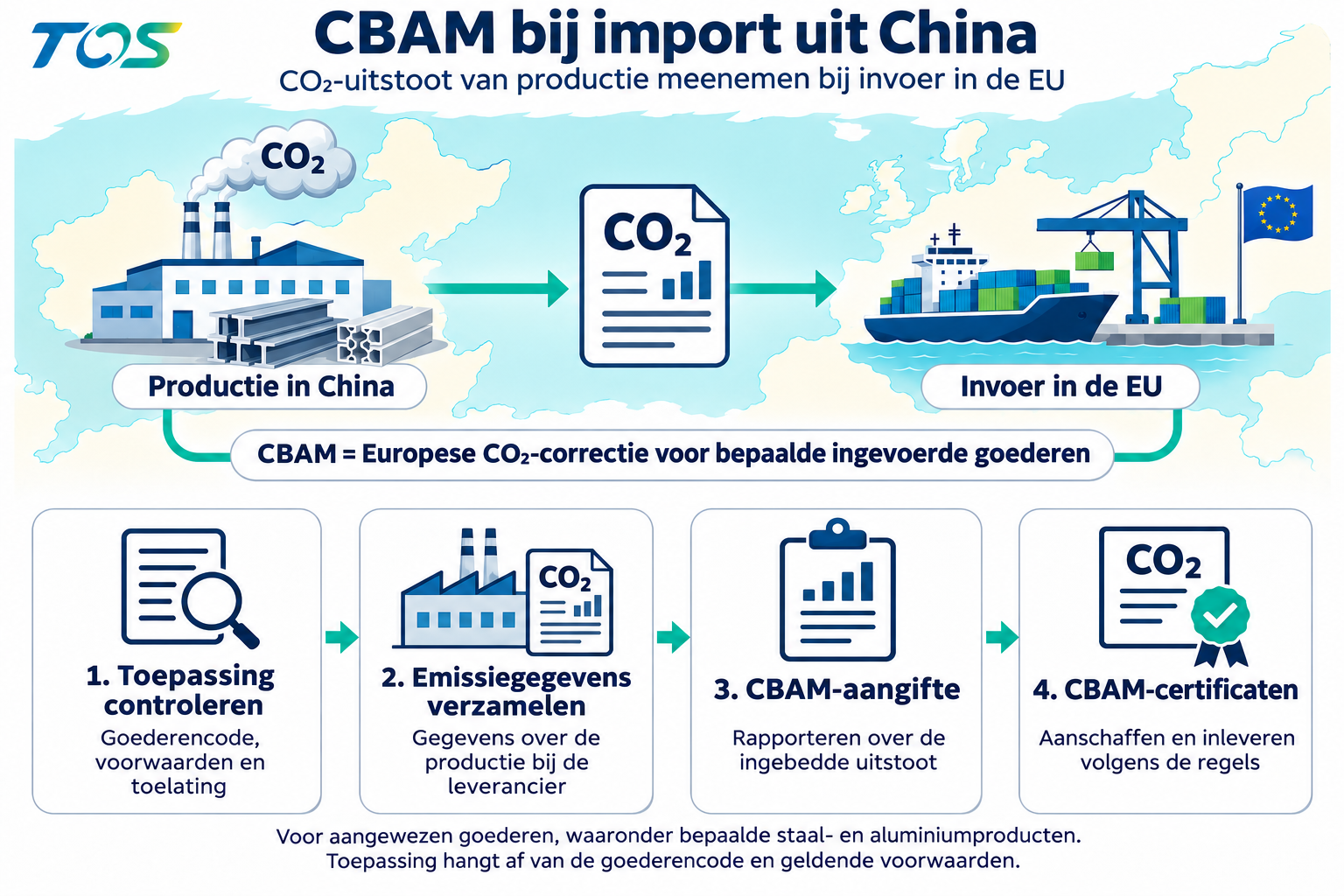
We also include CBAM. Certain goods, including designated steel and aluminum products, may be subject to obligations regarding CO₂ emissions during production. Whether this applies to your shipment depends, among other things, on the commodity code and the applicable application conditions. Where necessary, we request the required production and emission data from the supplier in a timely manner.
We link available documents to the product or batch in question via material and input inspection. A material certificate, origin document and CBAM data each have their own function. We therefore examine what information is required for each delivery.

Collect drawing, material, function and execution.

View commodity code and relevant import measures.

Clarify included items and responsibilities.

Connect shipment, invoice, packing list and transport details.

Answer questions and coordinate further delivery.
There is no fixed import percentage for all products from China. The classification, origin and applicable measures determine what applies to the product in question. The customs value also plays a role in the calculation. Depending on the delivery, certain transport and insurance costs may be included in addition to the product price.
In addition to import duties, import VAT and costs for transport and handling may play a role. Additional measures, such as anti-dumping duties, apply to some product groups. That is why we compare the costs based on the specific part and the agreed delivery route, not on the basis of one general percentage.
It must be clear to you which items are included in the offer and which are treated separately. We also agree who will act as importer and how the declaration and payment will be arranged. The official information about VAT on import can be found at the Tax Authorities.
CBAM may also be relevant for certain goods. This European mechanism relates, among other things, to selected products made of iron, steel and aluminum. Whether a product falls under this is determined by the designated commodity codes. The mere mention of ‘steel’ or ‘aluminium’ is therefore not enough to determine this.
During the preparation, we determine whether additional information is required and which party must take care of the relevant obligations. The current application conditions and any exemptions must be reviewed. Read the official explanation about CBAM at Customs Netherlands.
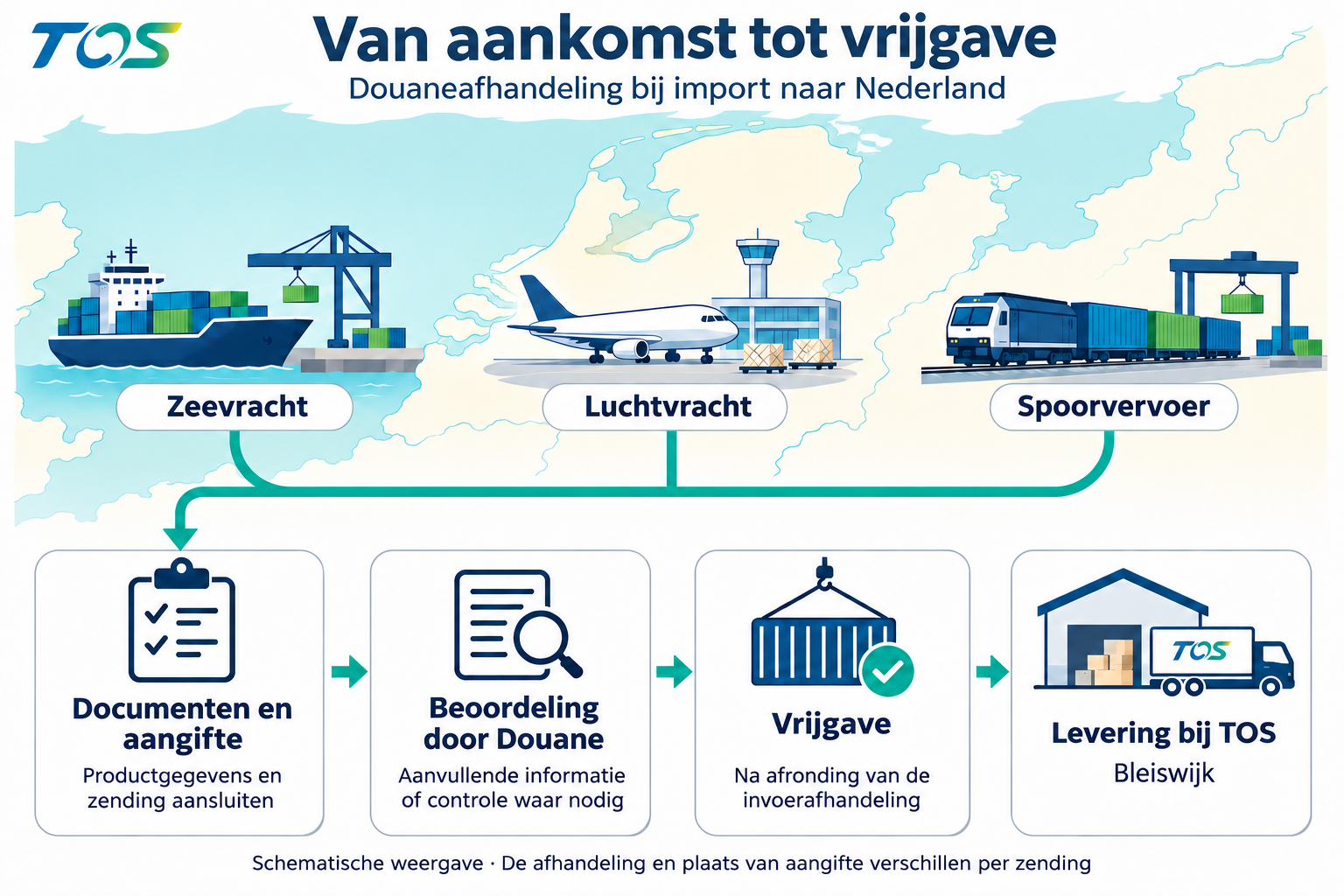
A well-prepared shipment may also be subject to an additional question or inspection. We therefore take the handling into account in the total delivery planning. With air freight and urgent shipments from China this is extra important: saving time during transport does not mean that import processing is no longer necessary.
With our joint containers from China are bundled into smaller orders. The content of each order must remain recognizable in the shipment details. After the necessary handling, the containers arrive at TOS in Bleiswijk, where we unload ourselves and distribute the orders for further delivery.
Customs preparation is part of the complete process of outsourcing production to China. TOS connects the production data with the agreed logistics. Also view our general page about customs clearance.
We link the order to the correct items and current execution. The product description must make it clear what is actually delivered.
Where necessary, we collect information about composition, material and use. This helps to assess a part or assembly correctly.
The tariff classification is reviewed for the specific product. A supplier code can be a starting point, but must match the actual goods.
We look at which measures are relevant for the classification and origin. If CBAM may be applicable, the required information will be coordinated in a timely manner.
We connect the product value to the agreed required delivery condition and transport details. This allows the relevant costs to be reviewed on a consistent basis.
We agree who will act as importer and how the import declaration and payment will be taken care of. The parties involved must have the correct information.
Item lines, quantities, packages and weights are compared with each other. A crate containing multiple products must also be recognizable in the documents.
We ensure that the required information matches the planned departure. The product release and any missing documents are also taken into account.
If additional information or a check is required, we coordinate the next steps with the parties involved and assess the influence on the planning.
After the required release, further delivery will be coordinated. When our containers arrive in Bleiswijk, we take care of unloading and distributing the orders ourselves.
This depends, among other things, on the commodity code, origin, customs value and any additional measures. There is no fixed percentage for all Chinese products. We look at the costs for the specific product and the agreed delivery.
Usually, a commercial invoice, packing list and transport details are required. Depending on the product, additional documents may be requested. We match the required information to the actual shipment.
No. CBAM relates to specifically designated goods. The commodity code and current application conditions are decisive. A metal part is not automatically covered because it contains steel or aluminum.
We will record this before delivery. TOS coordinates the preparation with the parties involved. It must be clear who acts as the importer, who takes care of the declaration and how costs and obligations are handled.
Yes. Additional questions or checks may also be required for air freight. That is why we include the import handling in the overall planning and do not treat an expected arrival as an unconditional delivery date.
Technical request
Upload a PDF, DWG or STEP/STP file and receive a detailed response about manufacturability, the production route and your request for quotation.