
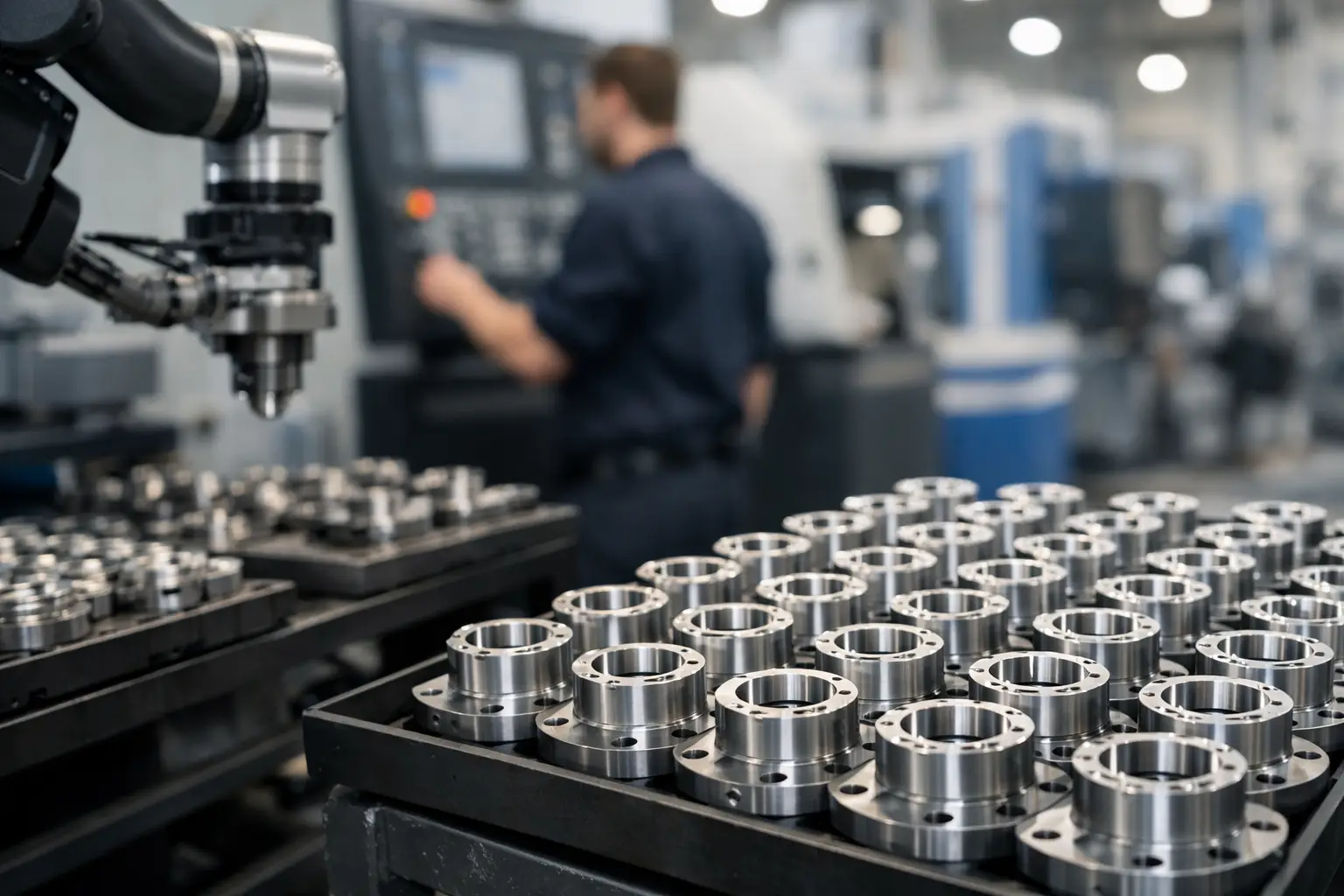
Outsourcing series production can release internal capacity, reduce investment and provide access to specialised manufacturing processes. The challenge is repeatability. One approved sample does not guarantee that the hundredth or ten-thousandth part will match it, arrive on schedule or carry the correct revision. Series production therefore needs a controlled system rather than a sequence of individual purchase orders.
This guide explains how OEMs can outsource recurring custom parts while maintaining control over specifications, capacity, quality, inventory and change management.
What counts as series production?
Series production covers repeated manufacturing of the same component or product in planned batches. The volumes can range from a few dozen precision parts per month to thousands of moulded or fabricated components. What matters is that the process, documentation and supply rhythm are designed for repetition.
The ideal production method depends on geometry, material, tolerances and volume. CNC machining may suit low-to-medium volumes and complex precision parts. Casting, forging or injection moulding can justify dedicated tooling at higher volumes. Sheet-metal fabrication and welding may use flexible fixtures for several product variants. A good outsourcing route selects the process for the full demand profile, not only for the first batch.
If the design is not yet validated, start with prototype manufacturing before committing to series tooling or stock.
Prepare a production-ready technical package
Stable series begin with controlled product data. Release the drawing, CAD file, bill of materials and specifications under one revision system. Define materials, critical dimensions, finishes, approved alternatives, inspection requirements and packaging. Every document supplied to the factory should carry a clear status and revision.
Separate product requirements from process suggestions. The supplier needs freedom to optimise non-critical steps, but must not change anything that affects form, fit, function, compliance or appearance without approval. A controlled deviation process allows temporary exceptions while preventing informal changes from becoming the new standard.
Before quotation, complete a design-for-manufacturing review. Small changes to radii, tolerances, material thickness or tool access can have a large effect when multiplied across recurring volumes.
Select a supplier for repeatability and capacity
A supplier that makes one good part is not automatically ready for series production. Assess how the factory plans capacity, maintains equipment, trains operators and controls tooling. Ask for evidence from comparable recurring programmes, including on-time delivery and non-conformance performance.
Match the supplier’s normal production model to your demand. A high-volume factory may give a low price but require batch sizes that create excessive inventory. A flexible shop may handle variants well but lack enough capacity for rapid growth. Review minimum order quantities, economic batch sizes, lead times, changeover time and available backup resources.
Check the full route, including subcontracted finishing and special processes. The prime supplier or coordinating partner must retain responsibility for quality and timing across the chain. Use the qualification steps in our guide to selecting a reliable manufacturing partner.
Move from prototype to a controlled pilot batch
The transition to series should include a pilot or pre-production batch. This validates the intended production equipment, fixtures, cycle time, inspection plan, packaging and documentation. It also gives the teams a realistic view of lead time and yield.
Approve a first article or initial sample report before authorising the complete batch. Critical dimensions, material and function should be verified against the controlled specification. If the production process uses multiple cavities, fixtures or machines, sampling must represent those sources.
Record all actions from the pilot. Drawing clarifications, fixture changes, process settings and inspection lessons should be incorporated into the released manufacturing package. Otherwise, knowledge remains with individuals and is lost when an operator or planner changes.
Create a series production control plan
A control plan describes what is checked, by whom, with which method and how often. It should focus on characteristics that influence product performance and on process steps where variation can be introduced. Typical controls include incoming-material verification, setup approval, in-process measurements, final inspection and packaging checks.
Inspection frequency should respond to risk and capability. New or unstable processes may need increased sampling; proven processes may justify reduced inspection. A critical feature may require 100% verification, while a stable non-critical dimension can use statistical sampling. The decision should be documented rather than left to the operator.
Define reaction plans for out-of-control results. The supplier must know when to stop production, quarantine stock, inform the customer and begin corrective action. TOS can coordinate quality control and pre-shipment inspections when production is carried out remotely.
Protect consistency with tooling and process control
Fixtures, cutting tools, moulds, gauges and welding jigs determine repeatability. Identify customer-owned tooling, record its condition and define preventive maintenance. For high-wear items, agree spare parts and replacement criteria before a failure stops production.
Where process settings affect quality, establish an approved window and control changes. CNC programmes, welding parameters, moulding recipes and coating settings should be revision-controlled. A new machine, production site or subcontractor may require revalidation even when the drawing is unchanged.
Tool ownership and access should be covered commercially. Specify who pays for maintenance, who may use the tool, how remaining tool life is reported and what happens if production transfers to another supplier.
Plan demand, batches and inventory together
Series production becomes unstable when the supplier receives irregular urgent orders without forecast visibility. Share a rolling forecast and distinguish forecast information from firm releases. Agree a frozen period, production lead time and the point at which raw material or capacity becomes financially committed.
Choose batch sizes using total cost. Larger batches may lower setup cost, but they increase stock, cash tied up and obsolescence risk. Smaller batches improve flexibility but may increase changeovers and transport frequency. The best balance depends on demand variability, component value and the risk of engineering changes.
Safety stock should cover a defined risk, not hide an unreliable process. Decide whether it will be held as raw material, work in progress or finished goods, and clarify ownership. A structured supply-chain plan can combine production releases, consolidation and transport.
Control revisions and engineering changes
Series products change. The danger is mixing revisions or creating obsolete inventory. Every engineering change should define the effectivity: a date, batch, serial number or purchase order from which the new revision applies. Old drawings and programmes must be removed from use, while retained records remain clearly marked.
Before approving a change, assess existing raw material, work in progress, finished stock, tooling and open orders. Decide whether old parts may be used, reworked or must be scrapped. Communicate the decision to every relevant sub-supplier.
Significant changes should repeat an appropriate level of first-article validation. A material substitution, new production site or revised critical feature can introduce risk even when the part looks similar.
Measure supplier performance over time
Track a small set of meaningful indicators: on-time delivery, accepted quantity, defect rate, corrective-action closure and responsiveness. Use consistent definitions. A shipment should not count as on time if it is incomplete, and reworked parts should not disappear from the quality data.
Review early batches more frequently, then move to a regular supplier review. Look for trends and recurring causes. The purpose is not only to score the supplier but to improve the system: clarify drawings, adjust packaging, remove unstable processes and align forecasts.
Total cost should also be reviewed. Unit prices can remain stable while internal expediting, inspection or inventory costs increase. Our article on reducing manufacturing costs through outsourcing shows how to include these hidden costs.
Integrate finishing, assembly and logistics
Series parts often move through multiple operations such as machining, heat treatment, coating, marking and assembly. Each handover can create delay, damage or traceability gaps. Map the complete process and make one party accountable for the final result.
Packaging must protect the defined quality through the actual transport route. Prevent corrosion, cosmetic damage, deformation and mixed batches. Labels should connect the delivery to the purchase order, part number, revision, quantity and inspection records.
For international production, include export documentation, consolidation, customs and transport time in the delivery plan. A production promise is incomplete until the parts are available at the required location.
Series production outsourcing checklist
- Release one controlled technical package and revision.
- Select the process and supplier for lifetime demand.
- Validate the real production route with a pilot batch.
- Approve the first article before the complete series.
- Define a risk-based control plan and reaction plan.
- Control tooling, programmes and process changes.
- Align forecasts, batch sizes and inventory ownership.
- Monitor quality, delivery and total cost over time.
Create a scalable production route
Outsourcing series production works when engineering, quality and supply-chain decisions reinforce one another. The result should be a repeatable route that can absorb changing demand without constant intervention from your team.
TOS coordinates supplier selection, technical preparation, pilot production, quality assurance and delivery for recurring custom parts. To assess a component, send its drawing, annual requirement, batch pattern and target delivery schedule through our contact page.