
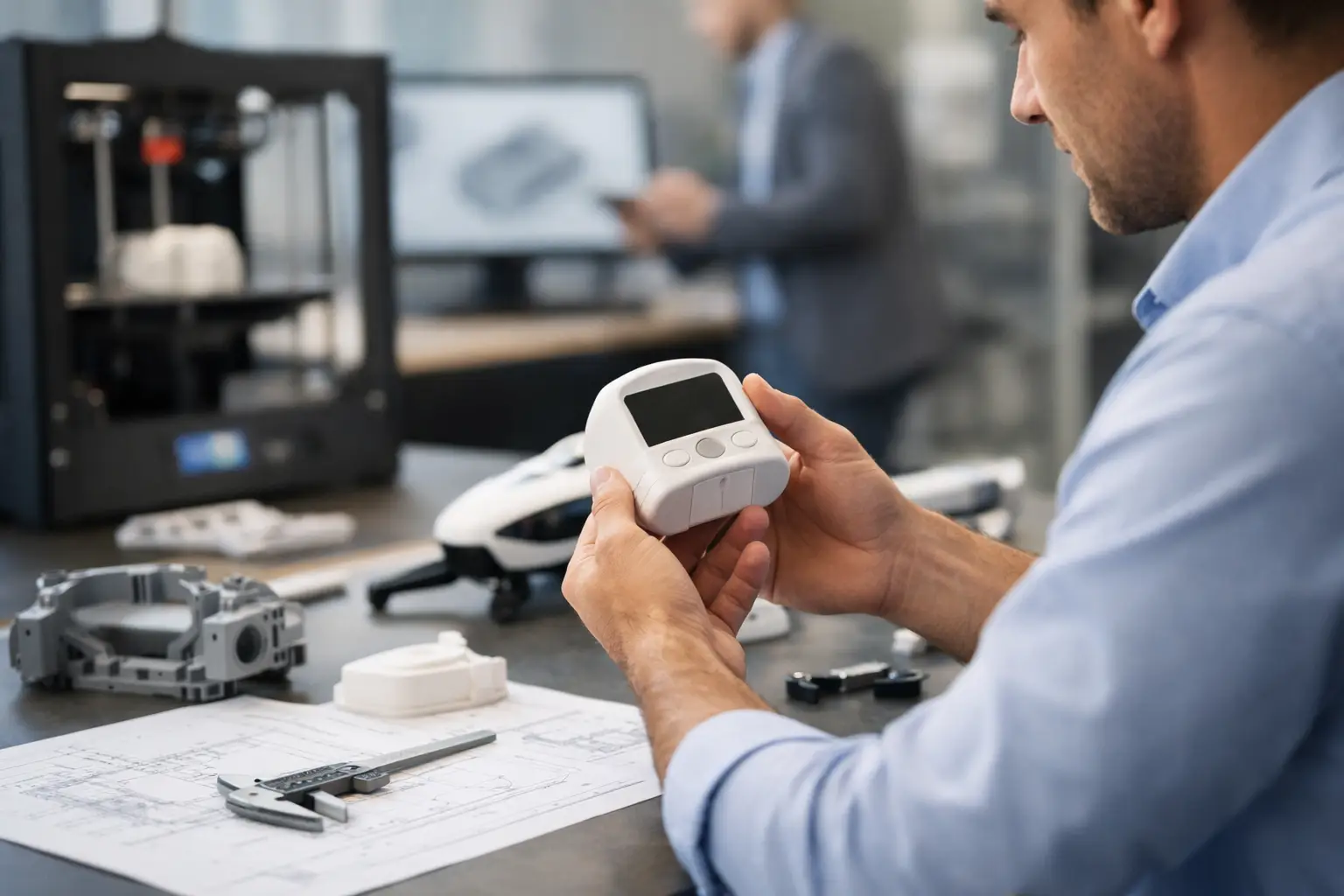
Outsourcing prototype manufacturing can accelerate product development, but only when the prototype is designed to answer the right questions. A fast sample that looks convincing may still provide little evidence about material performance, manufacturability or series cost. The prototype strategy must therefore match the stage of development and the decisions that follow.
For industrial products, prototypes often need to validate more than shape. They may need to confirm fit, load, tolerances, surface finish, assembly sequence, inspection methods and the selected production process. A controlled approach reduces redesign, prevents premature tooling decisions and creates a reliable bridge to pilot and series production.
What should an industrial prototype prove?
Before requesting a quotation, define the purpose of the prototype. Most projects need one or more of the following:
- Concept validation: confirm basic dimensions, ergonomics or the operating principle.
- Fit and assembly: verify interfaces, clearances, fasteners and access.
- Functional testing: test strength, movement, temperature, pressure or durability.
- Manufacturability: confirm that the geometry can be produced with the intended process.
- Appearance: assess finish, colour, texture or customer-facing details.
- Production validation: verify tooling, cycle time, work instructions and inspection.
A single prototype cannot always satisfy every objective. A low-cost concept model may be ideal for an early design review, while a production-intent prototype must use representative material and processes.
When outsourcing prototype manufacturing makes sense
External prototype manufacturing is useful when specialist equipment or experience is not available internally, when development capacity is limited or when the prototype should later transition to the same supply chain as the production part.
It is particularly valuable for CNC-machined parts, sheet-metal assemblies, castings, extrusions, plastic components and combined products that need several operations. A partner that understands both engineering and manufacturing can identify design risks before material and machine time are committed.
For a broader view of the design-to-production connection, read our guide to outsourcing engineering and manufacturing.
Choose a prototype process that matches the question
The fastest process is not automatically the best process. The decision should consider geometry, material, required accuracy, quantity and what the test must represent.
3D printing
Additive manufacturing is well suited to concept models, complex geometry and rapid design iterations. However, printed material behaviour, tolerances and surface quality may differ from the final production process. Use it when those differences do not invalidate the test.
CNC machining
CNC machining can produce accurate prototypes in production-grade metals and plastics without dedicated mould tooling. It is useful for functional testing and low quantities, although the machined geometry may not fully represent a later casting, forging or moulded part.
Sheet metal and fabrication
Laser cutting, bending and welding can create representative enclosures, frames and assemblies. Early attention to bend radii, weld access, distortion and finishing helps the prototype reflect the intended series route.
Soft tooling or production tooling
When the prototype must validate the actual moulding or casting process, temporary or production tooling may be required. This costs more and takes longer, but it can reveal process-specific behaviour that alternative prototype methods cannot show.
Apply design for manufacturing before ordering
A manufacturability review should take place while design changes are still inexpensive. Review material availability, standard stock sizes, machining access, minimum wall thickness, bend allowances, draft angles, tolerances, surface treatment and assembly sequence.
The aim is not to redesign the product around a supplier’s preferences. It is to distinguish functional requirements from avoidable complexity. Tighter tolerances, uncommon materials and unnecessary secondary operations can make a prototype slower and more expensive without improving the test.
TOS supports this phase through product optimisation, connecting design decisions to realistic production methods and target volumes.
Prepare a complete prototype package
Provide one controlled package rather than separate files and instructions across multiple emails. It should contain:
- the current 3D model and a dimensioned 2D drawing;
- material grade and any permitted alternatives;
- critical dimensions, datums and tolerances;
- surface finish, coating and cosmetic requirements;
- assembly and interface information;
- the purpose of the prototype and planned tests;
- inspection and documentation requirements;
- quantity, required delivery date and packaging expectations;
- a revision number and clear contact for technical questions.
Critical features should be explicit. If a dimension affects fit or a finish affects corrosion resistance, the supplier should know why it matters and how it will be evaluated.
Evaluate suppliers on more than speed and price
A prototype supplier needs the right machines, but also engineering judgement, reliable communication and suitable inspection equipment. Ask whether the supplier has experience with comparable materials and geometry, which operations are subcontracted and how design questions or deviations are recorded.
If series production is likely, assess the supplier’s scalability early. A workshop that is excellent at one-off parts may not have the process discipline, capacity or documentation needed for repeat production. Conversely, a high-volume factory may not be responsive enough for rapid development cycles.
Control quality without making the prototype unnecessarily heavy
The inspection level should match the purpose of the prototype. A visual concept model does not need a full dimensional report. A functional or production-intent prototype often does.
Define which characteristics require measurement, which certificates are necessary and whether test results must be included. For critical parts, a first article report can create the baseline for later pilot production. Our quality-control services can cover dimensional inspection, documentation and local supplier follow-up.
When a result falls outside specification, do not accept an undocumented correction. Record the deviation, its effect on the planned test and whether the drawing or process needs to change.
Use prototype feedback as controlled engineering data
A prototype only creates value when findings are converted into decisions. Capture assembly problems, test outcomes, dimensional results and supplier feedback. Then update the CAD model, drawing, bill of materials and test plan under a new revision.
Avoid manually modifying the prototype without reflecting the change in documentation. The physical sample may then work, while the released production data still contains the original problem.
From prototype to pilot series
After functional approval, a pilot or zero series should test repeatability and the complete production route. The objectives shift from “does the design work?” to “can the process reproduce it consistently?”
The pilot should validate fixtures, tooling, work instructions, inspection frequency, packaging and realistic lead time. It should also expose capacity constraints and subcontractor dependencies before the order volume increases.
Our detailed guide to contract manufacturing from prototype to series explains this transition and the release gates involved.
Common prototype outsourcing mistakes
- ordering a prototype without defining what it must prove;
- using substitute material for a test that depends on material properties;
- selecting a prototype method that cannot represent the final process;
- sending incomplete or conflicting revisions;
- specifying every dimension as critical;
- choosing a supplier only on the fastest promised lead time;
- approving a sample without documenting deviations;
- moving straight from one good prototype to full series production.
A practical seven-step approach
- Define the decisions and tests the prototype must support.
- Review the design for manufacturability and target volume.
- Select a representative prototype process and material.
- Release a complete, controlled technical package.
- Choose a supplier with suitable engineering and inspection capability.
- Inspect, test and record findings against the stated objectives.
- Update the design and validate repeatability in a pilot series.
Reduce risk before committing to production
Outsourcing prototype manufacturing should produce evidence, not just a physical part. With a clear objective, representative process, controlled documentation and focused inspection, each prototype round brings the design closer to reliable series production.
TOS can coordinate manufacturability review, supplier selection, prototype production, inspection and the transition to series manufacturing. Contact us to discuss the current stage of your product and the evidence needed before the next investment decision.