
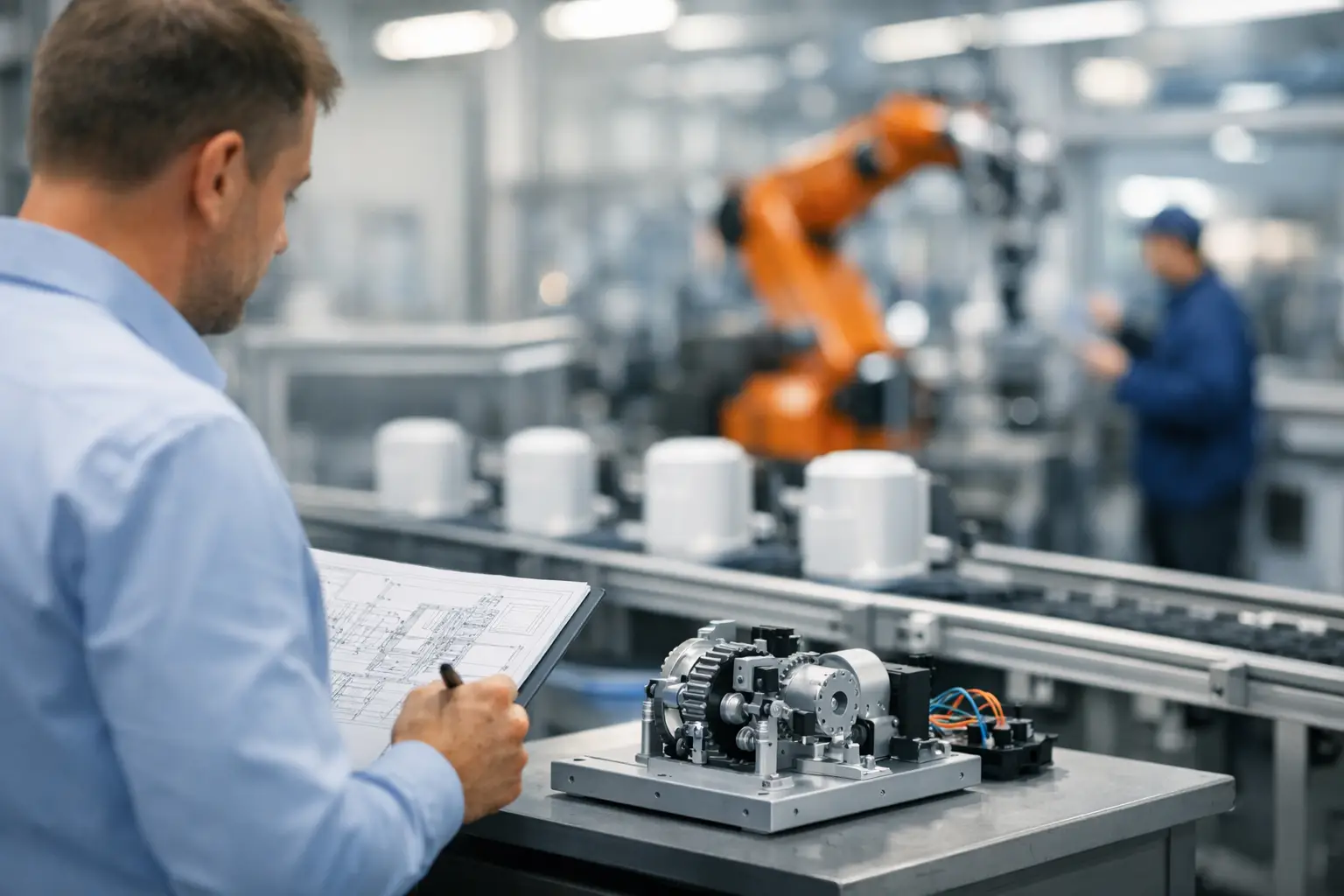
Moving from engineering to series production is one of the most critical stages in industrial product development. A prototype may prove that a design works, but it does not yet prove that the product can be manufactured repeatedly, economically and at the required quality level. Successful industrialisation closes that gap before volume rises.
The objective is not simply to find a factory that can make the part. It is to establish a controlled production system: a stable design, a capable process, approved suppliers, measurable requirements and evidence that every batch can meet them. The steps below provide a practical framework for engineering teams, technical buyers and OEMs.
Why prototypes do not automatically scale
Prototype manufacturing is optimised for speed and learning. Series production is optimised for repeatability, throughput and total cost. A CNC-machined prototype may be ideal for validation but too expensive at higher volumes. A hand-fitted assembly can conceal tolerance problems that become serious when components are produced by different suppliers.
This is why industrialisation must start before the design is frozen. A structured industrial product development process combines functional validation with manufacturing input, instead of treating production as a final handover.
1. Define production-ready requirements
Start with a controlled technical package. It should contain approved drawings, 3D models, a bill of materials, material and finish specifications, critical characteristics, test requirements, packaging instructions and the current revision. Remove conflicting information and identify which document takes precedence.
Tolerances deserve special attention. Apply tight limits only where function, fit, safety or compliance requires them. Unnecessarily narrow tolerances increase machining time, inspection effort and scrap. The goal is not the widest possible tolerance, but the correct tolerance backed by an agreed measurement method.
For multi-supplier programmes, transferable manufacturing documentation prevents process knowledge from remaining with one individual or factory.
2. Run a design-for-manufacturing review
A design-for-manufacturing review examines how geometry, material and assembly choices affect the intended process. Typical questions include:
- Can standard material sizes or grades be used?
- Are cutting tools, bends, draft angles and weld access practical?
- Can features be measured consistently?
- Can part count or assembly operations be reduced?
- Will the design remain robust when normal process variation occurs?
DFM should produce documented decisions, not informal suggestions. Record the reason for each change, its impact on function and the revision in which it is implemented. For cost-focused programmes, the related guide to redesigning a component to reduce unit cost provides a useful decision framework.
3. Select the production process and supplier together
Process selection depends on annual volume, geometry, material, surface requirements, investment and expected design stability. Flexible processes may be best while demand is uncertain; dedicated tooling becomes attractive when the design and volume justify it.
The supplier must have more than nominal capability. Verify equipment, process knowledge, capacity, quality controls, subcontracted steps and experience with comparable components. A formal supplier qualification should cover both technical fit and the ability to support ramp-up.
4. Validate with pilot production
Do not move directly from one prototype to full output. A pilot batch should use the intended materials, tooling, operators, work instructions and inspection plan. It reveals whether cycle times, fixtures, measurements, yields and packaging work under realistic conditions.
Approve critical dimensions and functional tests through a first-article or equivalent validation. Any deviation must have a clear disposition and corrective action. The production baseline is released only when the evidence is complete.
5. Control the ramp-up
During early series production, use tighter monitoring than during steady-state supply. Track first-pass yield, scrap, rework, process capability, on-time delivery and open corrective actions. Define who may approve changes to material, tooling, location, subcontractors or process parameters.
A controlled series production programme for custom parts also includes forecasts, order quantities, buffer policy and logistics. Quality and delivery must be managed as one system.
Common industrialisation mistakes
- Freezing the design before the supplier has reviewed manufacturability.
- Using prototype dimensions without verifying functional tolerances.
- Approving samples made with a different process from series production.
- Measuring unit price but ignoring tooling, scrap, inspection and inventory.
- Allowing undocumented supplier changes after approval.
- Increasing volume before corrective actions from the pilot are closed.
A practical release checklist
Before series release, confirm that the design revision is approved, critical characteristics are identified, the process and supplier are qualified, pilot results are accepted, inspection methods are agreed, tooling ownership is documented, packaging is validated and change control is active. The technical outsourcing roadmap shows how these gates fit into the wider sourcing process.
Conclusion
Engineering to series production succeeds when industrialisation is managed as a controlled transition rather than an administrative handover. Combining DFM, clear documentation, supplier qualification, pilot validation and disciplined ramp-up reduces surprises after launch. TOS coordinates these activities across engineering, suppliers, quality and logistics, giving OEMs one accountable route from design maturity to repeatable production.