
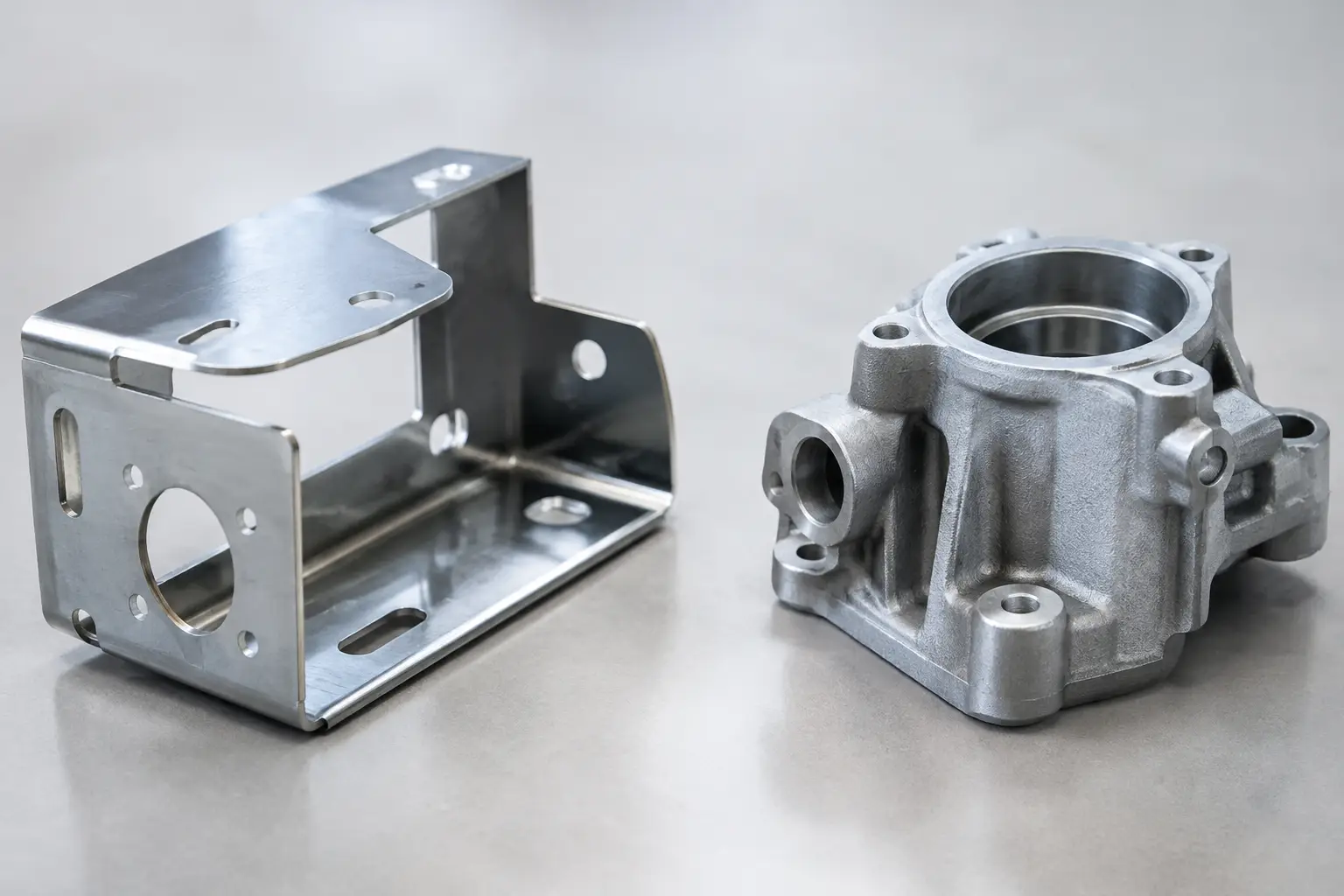
The decision between sheet metal vs casting should be made early, because each route shapes geometry, tooling, cost and supply risk. Sheet-metal parts are cut and formed from flat stock; castings are produced by filling a mould or die with molten material. Neither process is universally cheaper. The correct choice depends on function, volume and the complete manufacturing route.
When sheet metal is the better choice
Sheet metal suits brackets, covers, enclosures, frames and other parts with relatively uniform wall thickness. Laser cutting and bending allow fast prototypes without dedicated casting tooling. Design changes can often be implemented by updating programs and bend tools, making the route attractive while a product is evolving.
Fabrication can combine multiple sheets through welding, riveting or fasteners. This provides flexibility but creates more operations and potential variation. Bend radii, hole-to-edge distances, springback and tool access must be considered. For broader process planning, see our guide to improving part manufacturability.
When casting is the better choice
Casting can integrate ribs, bosses, curved surfaces, internal passages and complex three-dimensional geometry into one component. It is attractive when a fabricated assembly would require many pieces and joints. Depending on the casting process, high volumes can justify tooling and produce low unit costs.
Casting also introduces specific risks: shrinkage, porosity, distortion, draft, parting lines and variable surface condition. Critical features may still require machining. Tooling lead time and design changes can be significant, so the geometry and expected volume should be stable before commitment.
Compare the key decision factors
Geometry and part integration
Choose sheet metal for planar forms, bent profiles and assemblies that benefit from modular construction. Consider casting when complex shapes or multiple functions can be consolidated into one part. Part consolidation can reduce assembly work, but it may also concentrate failure and tooling risk in one component.
Production volume and tooling
Sheet-metal prototypes and low volumes typically need less dedicated tooling. Standard press-brake tools may be sufficient. Casting ranges from relatively flexible sand casting to high-investment die casting. Compare tooling amortisation across realistic lifetime volume, including maintenance and design-change risk.
Tolerance and surface finish
Laser-cut and formed features can be accurate, but bends and weldments introduce stack-up and distortion. Cast tolerance depends strongly on the selected process, alloy and geometry. Machining can establish precise datums and interfaces on both routes. Specify functional requirements instead of expecting one general tolerance across every feature.
Material and mechanical performance
Sheet products often have directional properties from rolling, while cast properties depend on alloy, solidification and heat treatment. Welding may change local properties in a fabrication. Compare load paths, fatigue, impact and corrosion requirements with a qualified engineer. Do not select on nominal alloy strength alone.
Lead time and design change
Sheet-metal parts can usually be sampled quickly. Cast tooling and process validation may take longer, especially for dies, cores or demanding inspection. If the product is still changing, the flexibility of sheet metal may outweigh a higher eventual unit cost.
Compare total cost, not only the primary operation
Include raw material, yield, cutting, forming, welding, casting tooling, machining, finishing, inspection, assembly and logistics. A casting may replace several fabricated items, while a sheet-metal design may avoid high tooling investment. Our guide to manufactured part cost drivers helps structure the comparison.
Validate the chosen route
Use prototypes or first articles to verify fit, strength, surface condition and assembly. For castings, connect sampling to the controls in quality control for overseas manufacturing. For aluminium applications, compare further alternatives in choosing an aluminium manufacturing process.
TOS can assess sheet-metal fabrication, casting and machining options, source qualified suppliers and manage quality through delivery. This avoids optimising one operation while overlooking the complete component cost and risk.