
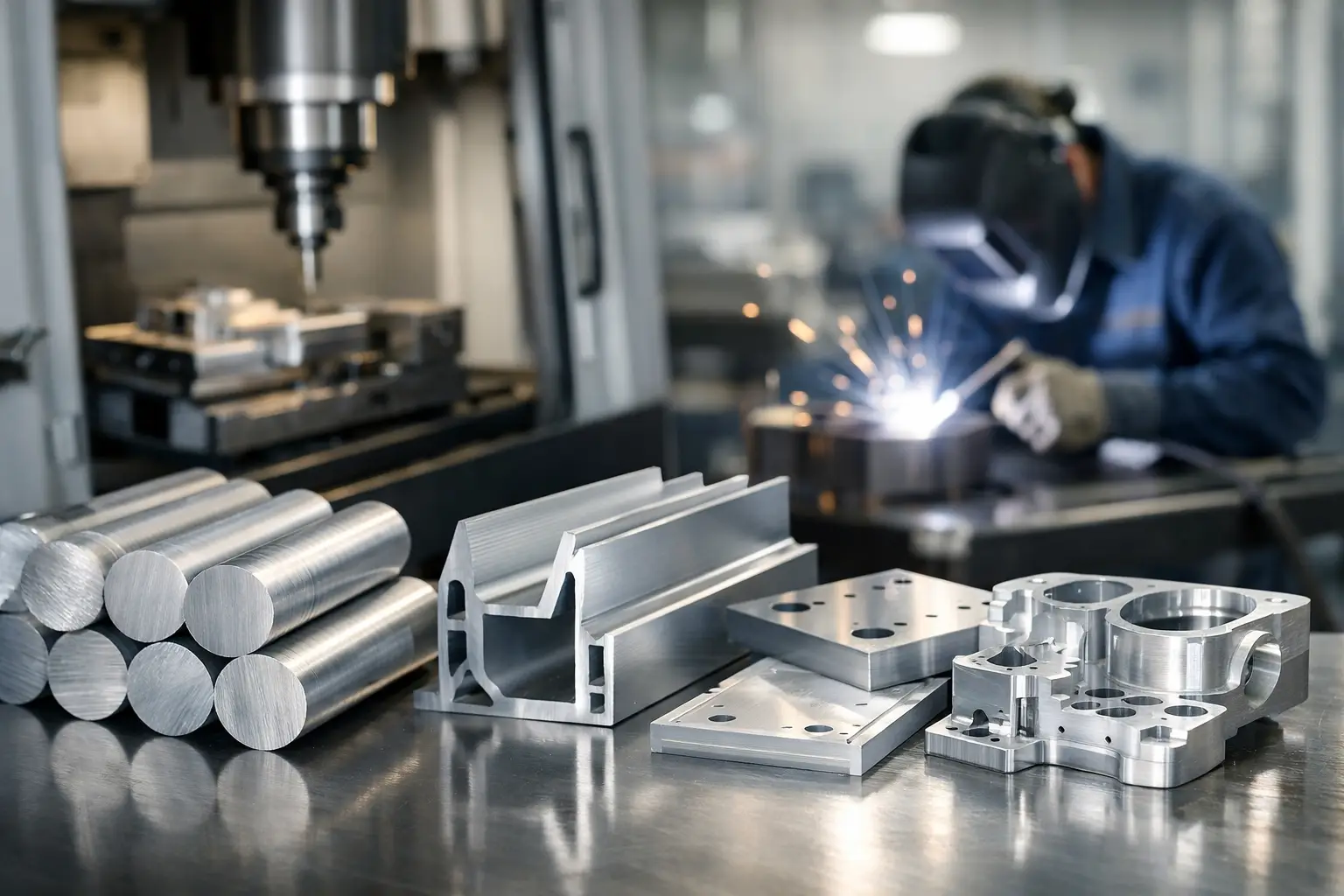
Choosing between aluminium manufacturing processes requires more than selecting a machine. Geometry, alloy, annual volume, tooling, tolerances, surface finish and mechanical properties determine which route provides the best total result.
CNC machining
Machining offers high flexibility and precision for prototypes, low-to-medium volumes and complex local features. It avoids dedicated forming tools but can create high material waste and cycle time when much stock is removed.
Use the controls in the CNC machining guide for supplier and inspection decisions.
Sheet-metal fabrication
Cutting, bending, punching and welding suit enclosures, brackets and frames. Standard sheet thicknesses and bend radii improve economy. Design must allow for springback, bend access and distortion.
Aluminium extrusion
Extrusion is effective for long profiles with a constant cross-section. Integrated channels, ribs and screw features can reduce assembly. Die investment and minimum quantities require a stable design and sufficient demand.
Read the custom aluminium extrusion guide for tooling and tolerance considerations.
Sand casting
Sand casting supports large or complex shapes and relatively low volumes with moderate tooling cost. Surface finish and dimensional variation are generally less precise than high-pressure die casting, so machining allowances may be needed.
Permanent mould and die casting
Metal mould processes improve repeatability and can reduce machining. High-pressure die casting is attractive for high volumes and thin, complex shapes, but tooling is expensive and design changes become costly.
Forging
Forging provides strong, fatigue-resistant components through controlled metal flow. It is valuable for highly loaded parts but needs dedicated tooling and process expertise.
Compare alloys and properties
Not every alloy suits every process. Wrought and casting alloys differ, and heat treatment affects strength, distortion and machinability. Select material and process together rather than naming an alloy before the route is understood.
Include finishing and secondary operations
Most parts need drilling, tapping, welding, anodising, coating or assembly. Coating build-up and heat treatment can affect final dimensions. Compare the complete finished component, not only the primary process.
A practical selection matrix
- Low volume and high flexibility: CNC machining or sheet fabrication.
- Long constant profile: extrusion.
- Complex low-volume shape: sand casting.
- High-volume thin shape: die casting.
- High structural loading: forging or appropriate wrought material.
Validate the decision through DFM, samples and total-cost comparison. The metal casting guide provides more detail for casting routes.
Match the process to annual demand and product life
Prototype quantity alone should not determine the production method. Consider expected annual demand, product lifetime, batch frequency and the likelihood of design changes. CNC machining may minimise initial investment, while extrusion, forging or casting can reduce unit cost after tooling and process approval. Model the break-even point with realistic scrap, finishing and inspection costs.
If the design is still evolving, keep the early process flexible. Once demand and geometry stabilise, a dedicated tool may be justified. Review the full manufacturing total cost of ownership rather than comparing part price alone.
Plan alloy, heat treatment and finishing together
The selected process limits available alloy forms and influences grain structure, porosity and dimensional stability. Heat treatment, anodising and machining allowances must therefore be considered before the drawing is released. Define whether critical dimensions apply before or after finishing and how surfaces will be protected during transport. A combined supplier quality and inspection plan should cover material identity, dimensions and finish.
Before committing to tooling, request representative samples and confirm how the chosen process controls critical features. The final decision should balance technical fit, repeatability, capacity, investment and supply risk—not simply the lowest quotation for the forecast volume.
Conclusion
The best aluminium manufacturing process balances performance, volume, investment and downstream work. TOS helps OEMs compare options, qualify suppliers and coordinate finished components from design through delivery.