
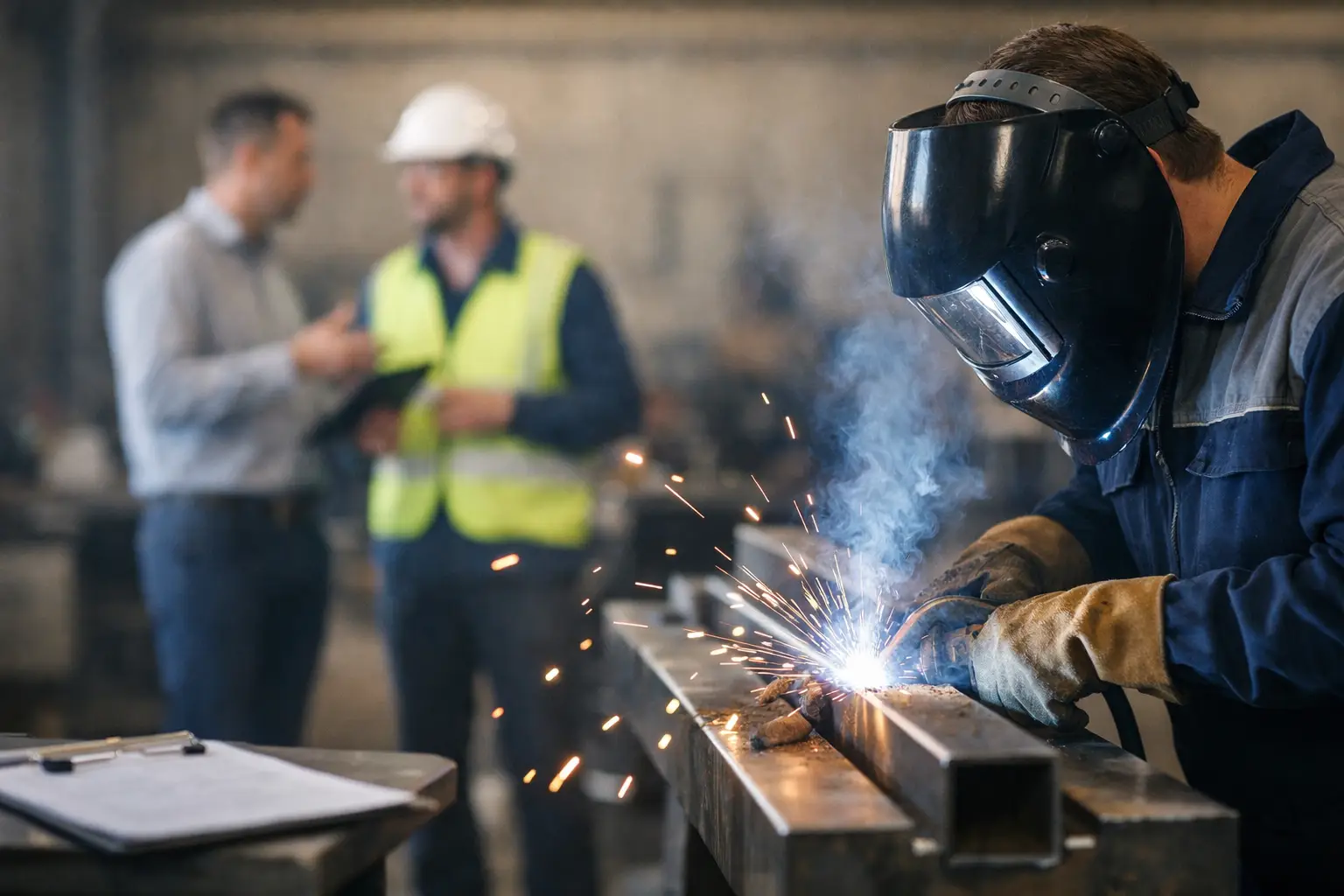
Outsourcing welding work is not simply a matter of finding a workshop with welding equipment. Welding is a special manufacturing process: the final result depends on design, material control, qualified procedures, operator competence, fit-up, heat input and inspection. Defects cannot always be removed by checking the finished assembly.
A reliable welding supplier must therefore demonstrate control of the complete process, from drawing review to shipment. This guide explains what to assess before placing series or project work.
Define the welded product and its risk
Start with function, loading, material, thickness, environment and consequence of failure. A cosmetic frame, machine base and pressure-containing assembly require different controls. State the applicable drawing, weld symbols, standards, acceptance levels and documentation.
Identify critical joints and inspection access. If fatigue, safety or leak tightness matters, involve a welding engineer before the request for quotation is issued.
Review design for weldability
Poor access, large thickness transitions, excessive weld volume and unbalanced joints increase distortion and cost. Review joint preparation, weld sequence, fixturing and whether machining is required after welding.
Design for manufacturing should reduce unnecessary weld length and make inspection possible. The broader principles in our product optimisation service can be applied before supplier selection.
Check welding procedures and personnel
Ask which welding processes will be used and whether the supplier has appropriate welding procedure specifications and qualification records. Confirm welder or welding-operator qualifications for the relevant process, material group and position.
ISO 3834 provides quality requirements for fusion welding, while application-specific standards may add requirements. Certification can support the assessment, but it must cover the relevant site and scope.
Assess material and consumable control
The supplier should maintain material identity and certificates where required. Review storage, issue and traceability of parent material, filler wire, electrodes and shielding gas. Consumables must be suitable for the specified material and service conditions.
For mixed materials or stainless steel, segregation and contamination control may be important. Define whether heat numbers must remain traceable to the finished assembly.
Evaluate production control
Observe cutting, preparation, fit-up, tack welding, fixturing and sequence control. Check how preheat, interpass temperature and heat input are monitored when relevant. Ask how distortion is predicted and corrected.
A capable supplier should explain the intended route for your assembly, not only show general procedures. This product-specific evidence is central to qualifying a manufacturing supplier.
Define inspection and acceptance
Visual inspection should occur throughout production, not only at the end. Depending on risk, additional non-destructive testing may include penetrant, magnetic-particle, ultrasonic or radiographic examination. State the required method, extent, acceptance criteria and inspector qualification.
Dimensional inspection is equally important. Weld shrinkage can move interfaces even when weld quality is acceptable. Define datums, final tolerances and whether post-weld machining is included.
Compare quotations on equal scope
Require suppliers to price material, cutting, welding, machining, treatment, inspection, documentation, packaging and transport consistently. Clarify whether fixtures and procedure qualification are one-time charges.
Compare total cost and expected yield, not only welding hours. Our international sourcing cost guide includes quality, logistics and internal coordination.
Validate with a production-relevant first article
The first assembly should use the intended material, procedures, personnel, fixtures and subcontractors. Review dimensional results, weld records, material certificates and inspection evidence before releasing a larger batch.
Record approved concessions and update the controlled data package. Do not allow a corrected prototype to hide an unstable process.
Control subcontracted processes
Heat treatment, blasting, coating, machining or non-destructive testing may be outsourced. Map these operations and verify how the welding supplier qualifies and monitors external providers. Define responsibility for defects found after a later process.
Welding supplier checklist
- Relevant materials, processes, thickness range and product experience
- Appropriate welding procedures and qualified personnel
- Material, consumable and traceability controls
- Fit-up, fixturing, sequence and distortion management
- Inspection methods, acceptance criteria and records
- Capacity, maintenance and delivery planning
- Control of heat treatment, coating and other sub-suppliers
TOS coordinates welded manufacturing from supplier selection to inspection and delivery. See our supplier quality audit checklist, explore custom manufacturing outsourcing, or contact us to review a welded assembly.