
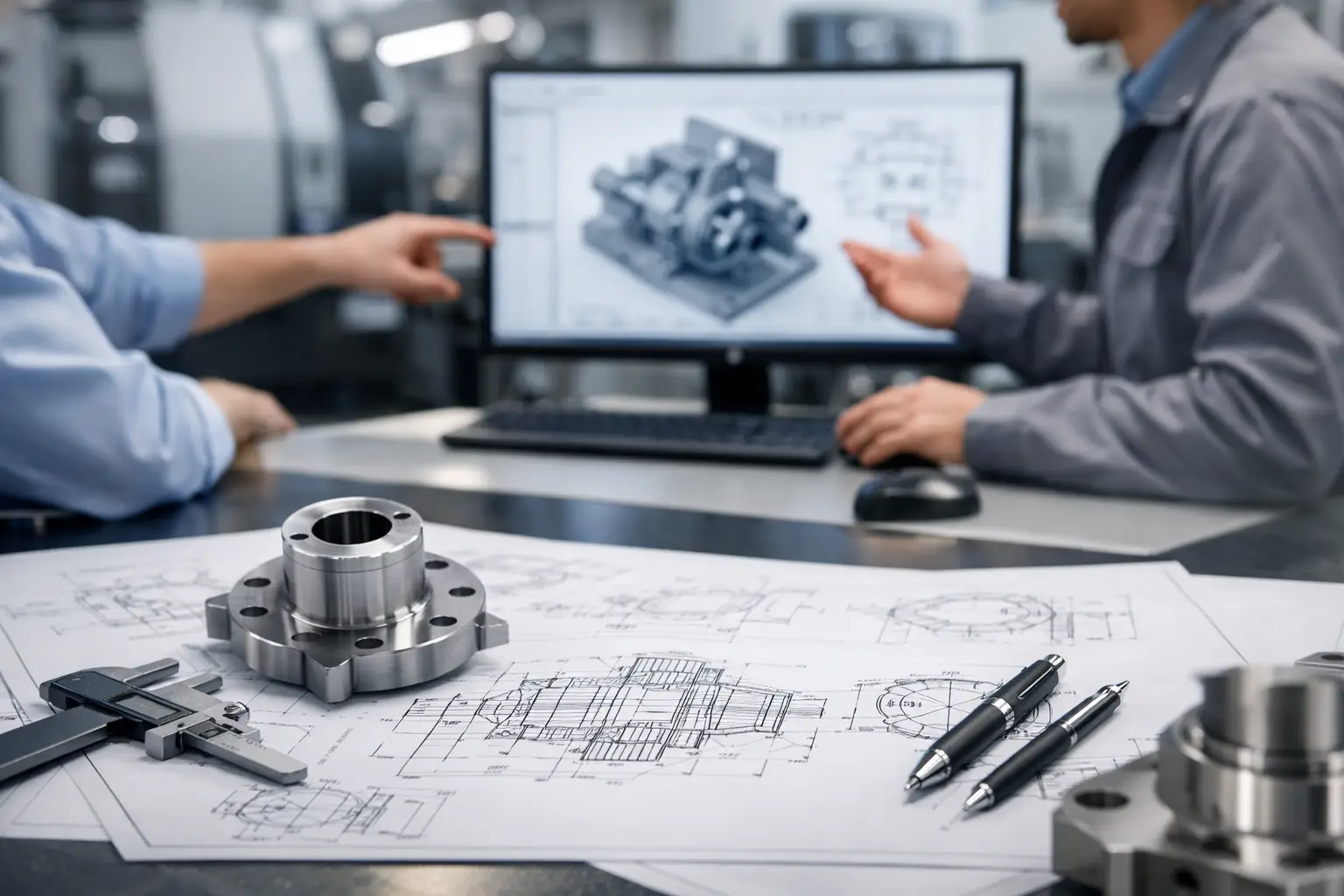
Outsourcing technical drawings can add drafting capacity, convert legacy information into controlled CAD files and prepare designs for external manufacturing. The value is not measured by how quickly a drawing looks complete, but by whether a supplier can manufacture and inspect the part without relying on assumptions.
A production drawing is a technical contract. It must communicate geometry, material, tolerances, finish, interfaces and revision status clearly enough to support repeatable production.
Define the purpose before assigning the work
Technical drawing work may involve converting sketches, updating existing drawings, producing manufacturing drawings from 3D models, creating assemblies or building a complete documentation set. State whether the drawing is for quotation, prototype, inspection or released series production.
Different purposes require different detail. A quotation drawing may permit open points; a production drawing must resolve them.
Specify the required deliverables
List the native CAD format, neutral files, PDF drawings, drawing standard, units, language and naming convention. Define whether the work includes a bill of materials, exploded views, weld symbols, surface specifications, inspection characteristics or assembly instructions.
For model-based workflows, identify which source governs when the 3D model and 2D drawing differ. Our guide to outsourcing 3D CAD design covers the wider model and DFM requirements.
Use functional datums and tolerances
Dimensions should reflect how the part functions and how it will be measured. Establish datums from stable, accessible features. Distinguish critical fit or position requirements from general tolerances. Avoid dimension chains that accumulate uncertainty across multiple features.
Geometric dimensioning and tolerancing can define form, orientation and position more effectively than plus/minus dimensions, but only when applied consistently. The drafter should understand the manufacturing and inspection implications of every symbol.
Include material, process and finish requirements
A drawing should identify the material grade and applicable standard, not only a generic description such as “steel” or “aluminium”. Define heat treatment, hardness, coating, roughness, colour or cosmetic zones when relevant. If equivalent materials are allowed, set approval criteria.
Do not prescribe a process unnecessarily when performance requirements are sufficient. Conversely, specify the process when it affects function, certification or validation.
Build in design for manufacturing
Drafting and DFM should not be separated. A clear drawing of an expensive or unstable design is still a poor production package. Review tool access, radii, bend relief, weld positions, stock sizes, assembly sequence and inspection access.
When changes are proposed, document their effect on function and cost. The article on redesigning a component to reduce unit cost gives practical examples of this trade-off.
Control versions and approvals
Use a unique part number, drawing number, revision and release status. Record who created, checked and approved the drawing. Changes should include a concise description and effective date. Suppliers must receive the current revision and confirm implementation.
Keep editable source files and release PDFs in a controlled location. A robust transferable manufacturing documentation system prevents an external drafter or supplier from becoming the only holder of essential knowledge.
Protect ownership and confidentiality
The agreement should state who owns newly created drawings, native CAD data, libraries and derived work. Define confidentiality, permitted use and the return or deletion of files. If subcontracting is allowed, require equivalent obligations from the subcontractor.
Ownership alone is not enough; ensure you actually receive usable native files and all referenced data.
Validate drawings against production
Before release, run an independent check for missing dimensions, conflicting notes, inaccessible measurements and mismatches between model, drawing and bill of materials. The manufacturing supplier should review the package and document open questions.
Use first-article inspection to confirm that the drawing can be interpreted and measured as intended. If recurring questions arise, improve the drawing rather than allowing unwritten shop-floor knowledge to become the standard.
Choosing an external drawing partner
Assess manufacturing knowledge, not only CAD software skills. The partner should understand the processes represented in your product, apply your standards, manage revisions and accept technical review. A short paid trial using a representative component is often more informative than a portfolio.
Where drawings are part of a broader project, outsourcing engineering and manufacturing together can reduce the gap between design intent and supplier execution.
Conclusion
Outsourcing technical drawings works when deliverables, standards, ownership and review are defined before work begins. Functional tolerancing, DFM and disciplined revision control turn CAD output into reliable production information. TOS can coordinate technical documentation with supplier feedback, validation and series release.