
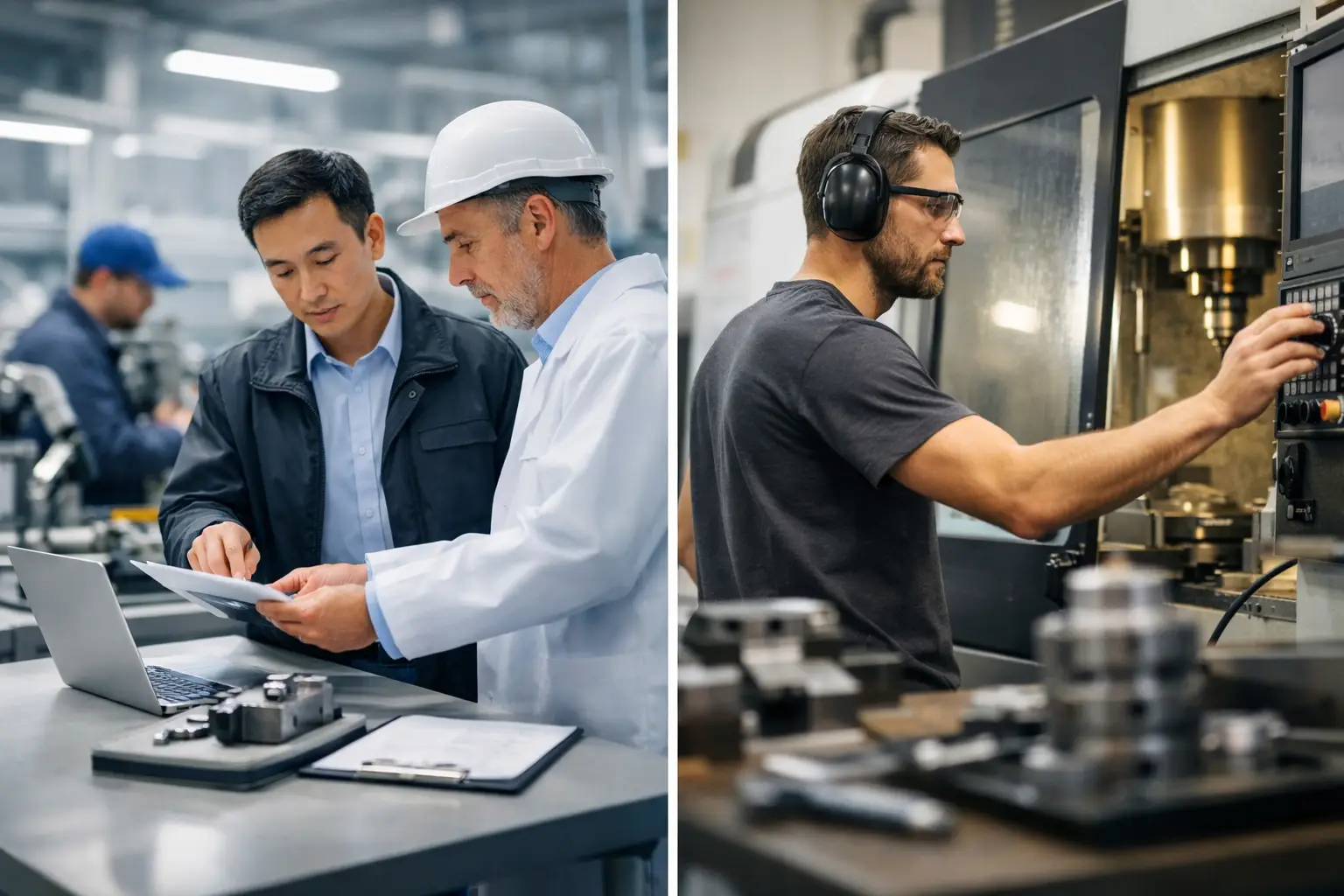
The choice between OEM outsourcing vs in-house manufacturing is not simply a comparison of two hourly rates. It is a make-or-buy decision about capability, capital, intellectual property, flexibility, quality and supply risk. The best answer can differ by product family and may combine internal production with qualified external capacity.
This guide provides a structured framework for deciding what an OEM should make, outsource or manage through a hybrid model.
Define the strategic role of the process
Start with competitive advantage. Keep a process in-house when it contains knowledge that directly differentiates the product, supports rapid experimentation or protects critical intellectual property. Internal production can also be valuable when immediate response and close cooperation between design and operators are essential.
Outsourcing is more attractive when the process is specialised but not strategically unique, requires equipment that is hard to justify, creates irregular capacity peaks or can be specified and verified objectively. External suppliers may provide deeper process expertise because they invest across several customer programmes.
Do not classify an entire product as make or buy. Break it into technologies and modules. You may retain final integration and testing while outsourcing machined parts, castings, finishes or stable subassemblies.
Compare the true cost of in-house manufacturing
Internal cost includes machines, financing, floor space, energy, maintenance, tooling, programming, operators, training, metrology, planning, scrap and management. Capacity utilisation matters: an expensive machine used intermittently can create a high cost per part even when direct labour appears low.
External cost includes price, tooling, supplier qualification, transport, customs, inventory, incoming control and internal coordination. Add the expected cost of non-conformance and delivery disruption. Use equivalent quality and service assumptions on both sides.
Our component-level guide to reducing manufacturing cost per part helps make this comparison without hiding one-time investment or quality losses.
Evaluate capital and capacity flexibility
In-house production can be attractive when demand is stable enough to use equipment and staff efficiently. It also gives direct control over scheduling. However, new technology or rising volumes may require a large investment before revenue is certain.
Outsourcing converts part of that fixed cost into variable cost. It allows access to several machines, processes or locations without owning them. This can support growth and protect internal capacity for strategic operations.
The trade-off is dependency. A supplier’s capacity serves other customers too. Confirm how forecast, reserved capacity and priority are managed. A low price does not guarantee availability during a market peak.
Assess technical capability and process maturity
Compare real capability rather than equipment lists. Does the internal team or supplier have experience with the material, geometry, tolerances, finishing and volume? Are programming, tooling, maintenance and measurement resources available?
A specialist supplier may achieve better yield and cycle time, while an internal team may understand product function more deeply. The best results often come from combining those strengths through design-for-manufacture reviews and controlled technical communication.
For custom components, custom manufacturing outsourcing should include engineering preparation, supplier matching and validation, not only order placement.
Compare quality control and accountability
Internal production provides physical visibility but does not automatically provide a capable process. External production creates distance but can still be controlled through complete specifications, audits, first articles, control plans and performance data.
Assess document control, calibration, process capability, traceability and corrective-action discipline for both options. Determine who approves deviations and who owns the cost when a part fails. Apply the same product requirements regardless of where production takes place.
When the process is outsourced, retain responsibility for defining and verifying requirements. ISO quality guidance treats outsourced processes as externally provided processes that remain within the organisation’s quality responsibilities.
Protect intellectual property and product knowledge
Identify what information the supplier needs to perform the work. A manufacturer normally requires enough design and process data to produce and inspect the part, but may not need the complete product architecture or customer application.
Use confidentiality agreements, access control, contractual ownership of tools and data, and a clear return or destruction procedure. Technical security should complement legal protection: share controlled files, restrict obsolete versions and record who receives them.
Keep enough internal competence to evaluate proposals, approve changes and transfer production if necessary. Outsourcing production should not mean outsourcing every ability to understand the product.
Consider speed and product-development needs
In-house production can shorten iteration when engineers and operators work side by side. External specialists can be faster when they already have the required process, tools and capacity. The deciding factor is usually the complete path from design to approved result.
For new products, prototypes may use a flexible external route while series production uses another supplier or returns in-house. Plan this transition early so the prototype does not create false confidence in series capability.
Our guide to reducing manufacturing lead times shows how technical readiness and supplier capacity affect speed.
Evaluate supply-chain and logistics risk
Internal manufacturing still depends on materials, tools and purchased components. Outsourcing adds another organisation and often additional transport. Map the complete chain for each option and identify single points of failure.
Consider supplier location, financial stability, raw-material sources, energy dependency, export capability and disaster recovery. For critical parts, alternatives may include safety stock, duplicate tooling or an approved second source.
Nearer production may offer shorter transport and easier visits, while a more distant specialist may deliver a large cost or capability advantage. Compare total landed cost and recovery time, not geography alone.
Use a weighted make-or-buy scorecard
Create criteria and weights before evaluating the alternatives. Typical categories include:
- strategic importance and intellectual property;
- lifetime cost and required capital;
- technical capability and quality performance;
- available capacity and scalability;
- lead time and change responsiveness;
- supply-chain resilience and transferability;
- internal management effort.
Engineering, operations, quality, procurement and finance should score the same evidence. Sensitivity analysis can show which assumptions change the decision. If a small demand shift reverses the result, a phased or hybrid approach may be safer.
When in-house manufacturing is usually stronger
- The process contains strategic product knowledge.
- Designs change frequently and require daily interaction.
- Demand is stable enough to use assets efficiently.
- Response time must be extremely short.
- The business already has proven process capability.
- External transfer would create unacceptable IP or continuity risk.
When OEM outsourcing is usually stronger
- Specialist equipment or expertise is required.
- Volumes fluctuate or growth is uncertain.
- Internal capacity is needed for more strategic work.
- The component has clear, measurable specifications.
- Qualified suppliers achieve better scale or material purchasing.
- Several processes can be coordinated in one external route.
Use a hybrid manufacturing model
Many OEMs do not need an absolute choice. Retain development, final integration or critical production internally and outsource stable components. Use external suppliers for overflow capacity while maintaining a core internal process. Split product families according to strategic value and maturity.
A hybrid model still needs clear governance. Define which route owns the master process, how changes reach every production location and how quality data is compared. Duplicate production without common controls can create two different products.
Validate the decision with a controlled pilot
Before transferring an important component, run a pilot with the intended supplier and production method. Evaluate quality, communication, lead time, documentation and total internal effort. Compare evidence with the internal baseline.
Qualify the external option using the process in our guide to choosing a reliable manufacturing partner. Use independent quality control where the product risk or distance justifies it.
Make the decision reversible where possible
Clarify tool ownership, data access, transfer assistance, spare parts and notice periods. Avoid supplier-specific design choices unless their benefit is worth the dependency. Retain controlled drawings and approval records.
Review make-or-buy decisions after major changes in volume, technology, quality performance or business strategy. A good decision at product launch may no longer be optimal three years later.
Choose the model that supports the product
OEM outsourcing is not a surrender of control, and in-house manufacturing is not automatically safer. Control comes from competent people, clear requirements, capable processes and evidence. The right model places each activity where it creates the best combination of strategic value, cost and resilience.
TOS can help compare production routes, qualify external capacity and manage transfer from first article to recurring supply. Share your product, volumes and current constraints through our contact page.