
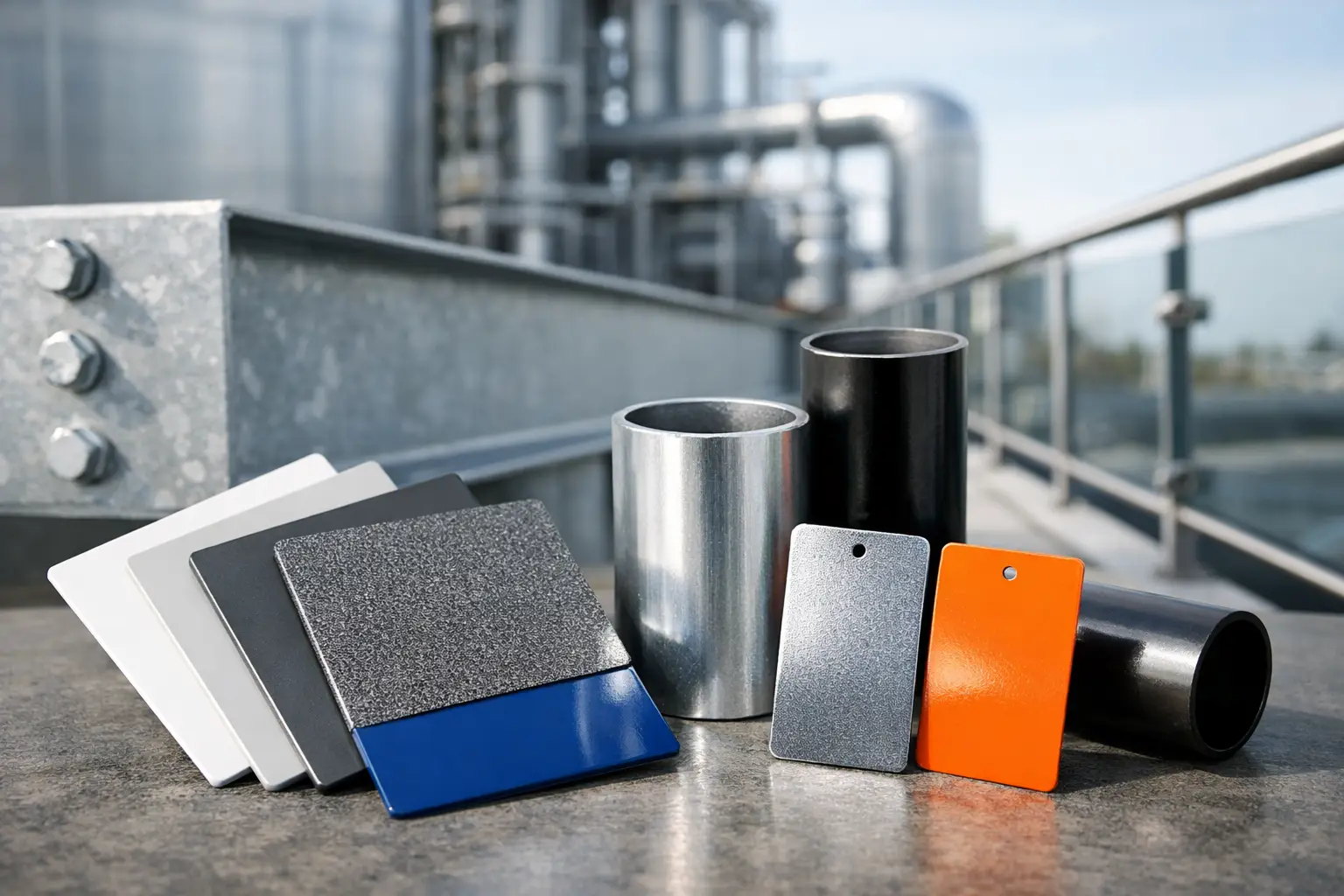
The right coating for steel parts depends on corrosion exposure, service life, appearance, dimensional requirements and how the component is manufactured. “Corrosion resistant” is not a complete specification: different systems protect steel through different mechanisms and create different design constraints.
Define the service environment
Start with indoor or outdoor exposure, humidity, salt, chemicals, temperature, abrasion and maintenance access. A decorative indoor bracket needs a different system from a welded frame near the coast. Define the expected life and acceptable maintenance interval.
Powder coating
Powder coating provides a durable coloured finish and is widely used for machinery and enclosures. Performance depends on surface preparation, chemistry, film thickness and curing. Edges, cavities and welds need careful design and pretreatment.
Use the specifications in the transferable manufacturing documentation when that process is selected.
Wet paint systems
Liquid coatings offer broad colour and chemistry choices and can suit large structures or repairable systems. Multi-layer primer and topcoat systems can provide high protection, but application conditions and cure must be controlled.
Hot-dip galvanising
Hot-dip galvanising creates a zinc coating with strong corrosion protection, including many edges and internal surfaces. The heat and coating thickness can affect distortion, threads and fit. Components need drainage and venting features.
For a process comparison, see manufactured part cost drivers.
Electroplated zinc and zinc alloys
Electroplating produces thinner coatings suited to smaller components and fasteners. Conversion coatings and sealers affect corrosion performance and appearance. High-strength steels require control of hydrogen-embrittlement risk.
Thermal spray and duplex systems
Thermally sprayed zinc or aluminium can protect large steel items. A duplex system combines zinc protection with paint or powder coating, often extending service life and adding colour.
Dimensional and functional considerations
Coating thickness changes threads, fits, holes and contact surfaces. Mask or machine critical areas where needed. Electrical grounding, welding, sealing and friction may also influence selection.
Specify measurable acceptance criteria
State surface preparation, coating system, colour, thickness range, adhesion, appearance zones and test requirements. Define repair rules and packaging to prevent transport damage. A supplier should not choose the system from colour alone.
Compare total cost
Include preparation, application, masking, inspection, transport, maintenance and expected life. The cheapest first coat may cost more if it requires frequent repair or causes assembly problems.
Where several finishes are involved, the manufacturing outsourcing best practices help control subcontracted processes and records.
Validate the complete coating system
A coating cannot be assessed only by colour or nominal thickness. Surface preparation, edge condition, pretreatment, application and curing all influence adhesion and corrosion resistance. Ask the supplier to describe the complete system and the process controls used for each stage.
For a new application, agree representative test panels or coated samples and define the required evidence. This may include thickness readings, adhesion results, salt-spray exposure or appearance standards. Put the agreed checks in a supplier quality and inspection plan.
Account for handling and repair
Threads, bearing fits, electrical contact areas and weld zones may need masking. Packaging should prevent metal-to-metal contact and moisture entrapment. Also agree how small transport or assembly damage may be repaired, because a touch-up product does not always provide the same protection as the original industrial coating.
Record the approved coating supplier, product system, colour reference and acceptance sample. If any element changes, assess the effect before the next batch. This is particularly important when coating performance is tied to warranty, outdoor life or customer appearance requirements.
Conclusion
Choosing a coating for steel parts is an engineering decision based on environment, geometry, service life and function. TOS helps define requirements, select capable finishing suppliers and integrate coating inspection with the complete production route.