
Hollow metal parts · From sheet to finished product

Deep drawing in China

Do you want to have metal caps, sleeves, shells or housings made in series? TOS supervises deep drawing in China based on the drawing and function of your product. We coordinate material, deep-drawing tools, trial production and further processing with a suitable production partner.

You can request a formed part or a completely finished part, including trimming, holes, any CNC machining, surface treatment and assembly. You have one Dutch point of contact for technical coordination, control and delivery.

Afgewerkt en gecoat onderdeel geproduceerd via dieptrekken bij TOS

From flat sheet to a functional hollow part

Part geometry as the starting point

Depth, radii, flanges and connection dimensions are reviewed based on the application of the end product.

Match material and tooling

The exact sheet grade and delivery condition partly determine formability and the required drawing stages.

Tooling matched to the series

TOS compares tooling costs, expected volumes and secondary operations within the complete production route.

Inspection of critical characteristics

In addition to dimensions, wall thickness, surface, edges and functional fit can be part of the inspection.

Delivered completely finished

Trimming, holes, cleaning, protection and any assembly are included in the required delivery condition.

Seriematige productie van getrokken metalen onderdelen bij TOS

What is deep drawing and when is it appropriate?

With deep drawing, a flat metal blank is formed into a hollow shape using a punch and die. The material flows in from the edge during shaping. A pleat holder helps control that material supply. Depending on the shape, several pulling steps may be necessary.

The technique can be suitable for recurring series of hoods, sleeves, shells and technical housings. A hollow basic shape can be formed from one sheet. This means that weld seams can no longer be in that basic form; Later connections or assembly may require welding.

With punching and punching the emphasis is on contours and holes. Deep drawing actually forms the hollow product geometry. Cutting, punching and forming operations can follow each other in the same production route.

For open, angular shapes or a design that often changes, we also compare edging and bending with any welded connections. The manufacturability and total costs of the end product determine the choice.

We further elaborate on the tool selection, trial production and release at sheet metal molds in China. There we deal with deep drawing molds and the combination with stamping, punching and progressive operations.

Is deep drawing in China economically suitable? A product-related mold requires preparation and investment. A stable drawing and recurring purchases can help spread those costs over the series. TOS assesses tooling, material consumption, drawing steps, finishing, inspection, packaging and transport together. A single emergency part or a design in development often requires a different consideration. There is no fixed minimum series for all deep drawing products.

Dieptrekken van metalen onderdeel met glad oppervlak bij TOS

Outsource deep drawing parts in 5 steps

1. Assess application

Drawing, 3D model, material, function, quantities and desired delivery condition form the basis.

2. Pull route and die

We coordinate manufacturability, drawing steps, tools and any design adjustments.

3. First products

The first parts are reviewed for agreed dimensions, shape, surface and functional characteristics.

4. Series and finishing

After release, series production, trimming, additional processing and surface treatment follow.

5. inspection and delivery

The agreed final inspection, packaging and logistics are in line with the deliverable end product.
Material, tensile radii, wall thickness and tolerances

The right sheet quality. Steel, stainless steel and aluminium can be deep drawn, but not every quality or delivery condition is equally suitable. State the material standard, exact quality and starting thickness. The choice is reviewed in combination with shape, application and desired finish.

Radii and drawing depth. Sharp transitions and a large depth can make forming more difficult. Bottom radius, corner radius and flange width are therefore reviewed together. Sometimes multiple drawing steps or a modified geometry are required.

Wall thickness and surface. The local thickness may change during forming. Determine where a minimum wall thickness is functional. Cracks, folds, tool marks and requirements for visible surfaces are also part of the assessment and acceptance agreements.

Functional dimensions. Indicate measurement references, critical diameters, shape dimensions and mounting surfaces. The starting thickness is not an automatic guarantee for an equal end wall everywhere. Achievable tolerances are confirmed per product; an accurate fit may require additional calibration or finishing.

Finishing and fit. Agree on the requirements that apply after cleaning, coating or mounting. A surface treatment can affect the fit. Any tightness requirements and the associated control are recorded separately.

When is a thermoformed part from China suitable?

TOS supervises the complete deep drawing route

Deep drawing is one step towards a usable product. After forming, edges can be trimmed, holes made and connections made. Where geometry and fixtures permit, CNC machining can add functional surfaces or holes. With thin-walled parts, threads sometimes require a different design or a separate mounting part.

Cleaning, deburring and a suitable surface treatment are part of this route. TOS tailors quality control and packaging to the shape, visible surfaces and desired delivery condition.

Mold costs and unit prices are distinguished in the application. Determine in advance what the tools cover and what agreements apply to ownership, maintenance, storage and changes. Also view our general explanation of deep drawing and the overview of outsourcing production to China.

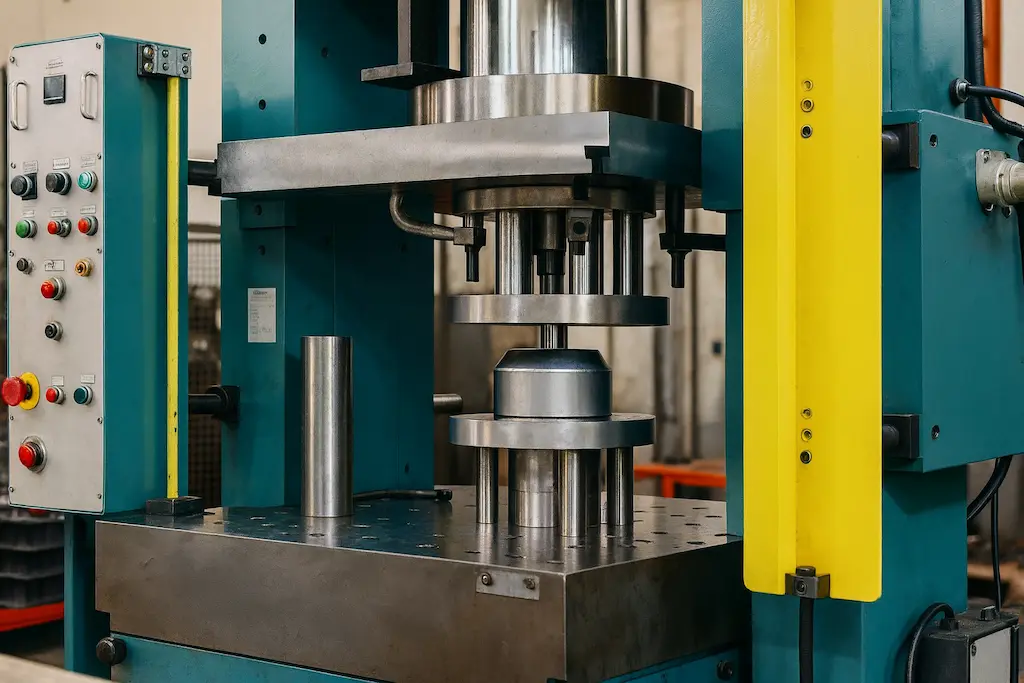
Hydraulische pers voor dieptrekken van metaal bij TOS

You share the current final drawing, preferably a STEP model, material and quantities. Indicate application, revision, critical dimensions, visible surfaces, any tightness requirements and desired delivery condition.

The partner assesses the hollow shape, drawing depth, radii, flanges and accessibility of subsequent operations. Possible design adjustments are submitted for approval.

The exact sheet quality, thickness and delivery condition are linked to the desired deformation. The route includes the result and the required number of pulls and any intermediate operations.

The quotation distinguishes between moulds, first products and series production. Ownership, maintenance, storage and change management of the tools are agreed in advance.

The production partner develops and makes the tools for the agreed shape. Test pulling shows whether the material supply and tool settings lead to an acceptable product.

First parts are reviewed on the established dimensions, shape and surface. Where necessary, wall thickness, fit or an agreed functional test are included. Corrections are made prior to serial release.

The series follows the approved drawing and production route. The inspection focuses on agreed characteristics and on deviations that may arise during pulling or due to tool wear.

Trimming, making holes, deburring and any CNC or welding operations make the formed part suitable for its function. The order is tailored to dimensions and clamping.

Cleaning and the chosen surface treatment follow the agreed delivery status. Assembly and final inspection take into account protected surfaces, functional fit and visible work.

The packaging prevents damage or deformation of edges and thin walls. Required measurement reports and material data are agreed in advance. TOS coordinates logistics and delivery.

Frequently asked questions about deep drawing in China

For which products is deep drawing suitable?

Deep drawing can be suitable for hollow metal series products such as caps, sleeves, shells and housings. Radii, depth, material, tolerances and quantities determine the feasibility. For open or angular products, bending and welding can be a suitable alternative.

This varies per material, starting thickness and product shape. An acute angle or large pulling depth may require additional pulling steps or a modified shape. The production partner confirms the feasible route based on your drawing; there is no general maximum draw depth.

Not automatically. A base formed from one sheet can be made without a connection weld, but that does not prove leak-tightness of the end product. Holes, connections and subsequent connections can affect function. State the tightness requirement and agree on an appropriate test.

There is no universal minimum series. Share the first order, expected repeat orders and the stability of the design. TOS compares the investment in molds and trial production with the unit price and total delivery costs, including finishing and transport.

Provide a current drawing and, where possible, a 3D model, with material, initial thickness, quantities and finish. State critical dimensions, minimum wall thickness where functional, visible surfaces, fit and desired documentation. Also indicate whether separate parts or a completely assembled product are required.