
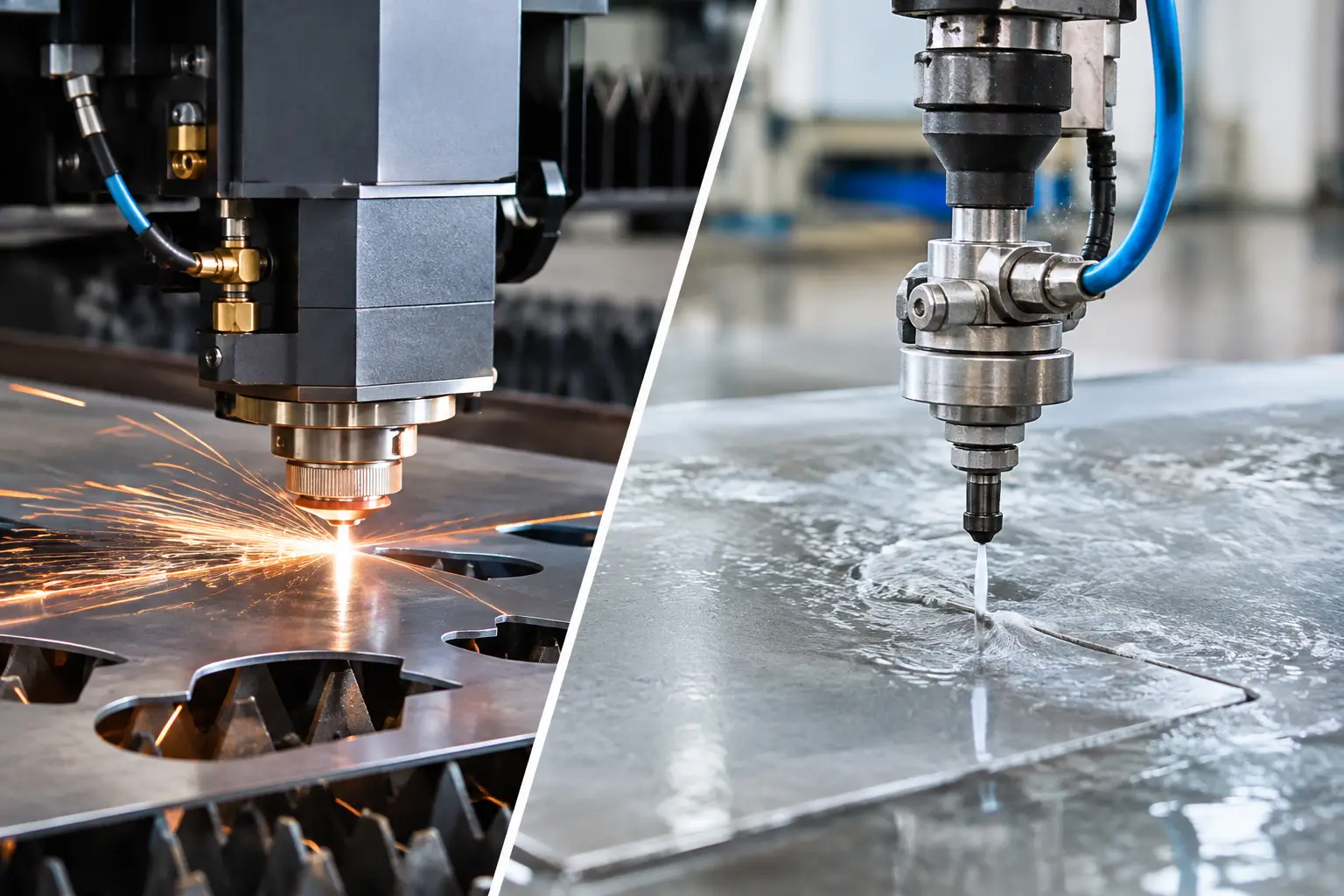
The choice between laser cutting vs waterjet cutting affects edge quality, tolerance, downstream work and cost. Both processes can produce complex two-dimensional profiles, but they remove material in fundamentally different ways. Laser cutting uses concentrated heat, while abrasive waterjet cutting uses a high-pressure stream with abrasive particles. The best option depends on more than thickness alone.
Choose laser cutting for speed and precision in sheet metal
Laser cutting is often the most economical route for thin to medium sheet metal, especially steel, stainless steel and aluminium. Modern fibre lasers cut rapidly, produce narrow kerfs and integrate well with automated loading and nesting. They are well suited to brackets, panels, covers and profiles that will be bent or welded. For a broader sourcing approach, see our guide to outsourcing metalworking.
The thermal process does create a heat-affected zone. Depending on material, thickness and settings, this can influence hardness, oxide condition or the performance of a later coating or weld. Small holes, sharp corners and reflective materials require capable equipment and validated parameters. Burrs may still need removal even when the cut appears clean.
Choose waterjet for material flexibility and no heat-affected zone
Waterjet cutting can process metals, stone, ceramics, composites, plastics and other materials without a thermal heat-affected zone. It is valuable for thick plate, heat-sensitive alloys, laminates or materials that are difficult to cut thermally. The process can also reduce the need for dedicated tooling during prototypes and low-volume production.
Waterjet is generally slower than laser on thinner sheet and may have a wider kerf. Edge taper, striations and piercing marks depend on thickness, nozzle condition, speed and quality setting. Abrasive consumption and wastewater handling also contribute to cost. The process is “cold,” but that does not mean every part leaves the machine finished.
Compare the decision factors
Material and thickness
Start with the material specification and section thickness. Laser is highly productive for common sheet metals within the machine’s power range. Waterjet handles a much wider mix of materials and very thick sections. Ask suppliers for proven examples in the same grade and thickness rather than relying only on catalogue capacity.
Tolerance and edge requirements
Define functional tolerance, perpendicularity, roughness and burr acceptance. Laser can be extremely accurate on sheet, while waterjet quality depends on speed and compensation for taper. If critical faces will be machined later, optimise the blank for machining allowance rather than purchasing unnecessary cut-edge precision. Our article on improving part manufacturability explains this functional approach.
Heat sensitivity
Use waterjet where thermal influence could damage the material or compromise later performance. For conventional fabricated steel parts, laser’s heat effect is often manageable when the process and follow-up operations are controlled. Make the decision with the complete process route in mind, including bending, welding, machining, heat treatment and coating.
Speed, volume and nesting
Laser usually offers higher throughput for sheet-metal series. Waterjet can be attractive for prototypes, mixed materials and thick plate. Nesting efficiency affects both routes because unused material becomes cost. Compare quotations using the same quantity, material format and delivery scope.
Do not compare machine rates alone
Total cost includes programming, setup, material yield, cutting time, consumables, deburring, inspection, packaging and lead time. A cheaper cut can become more expensive if it requires extensive finishing or causes problems in welding. Review the broader factors in manufactured part cost drivers.
Use a representative sample
For critical parts, ask both suppliers to cut a representative geometry in the actual material and thickness. Inspect small features, corners, edge condition, distortion and downstream fit. A sample provides better evidence than a general capability statement.
TOS can help select and manage the appropriate cutting and fabrication route, including bending, welding, machining, finishing and inspection. For components that combine multiple operations, our guide to technical manufacturing outsourcing explains how to keep responsibility and quality control connected.