
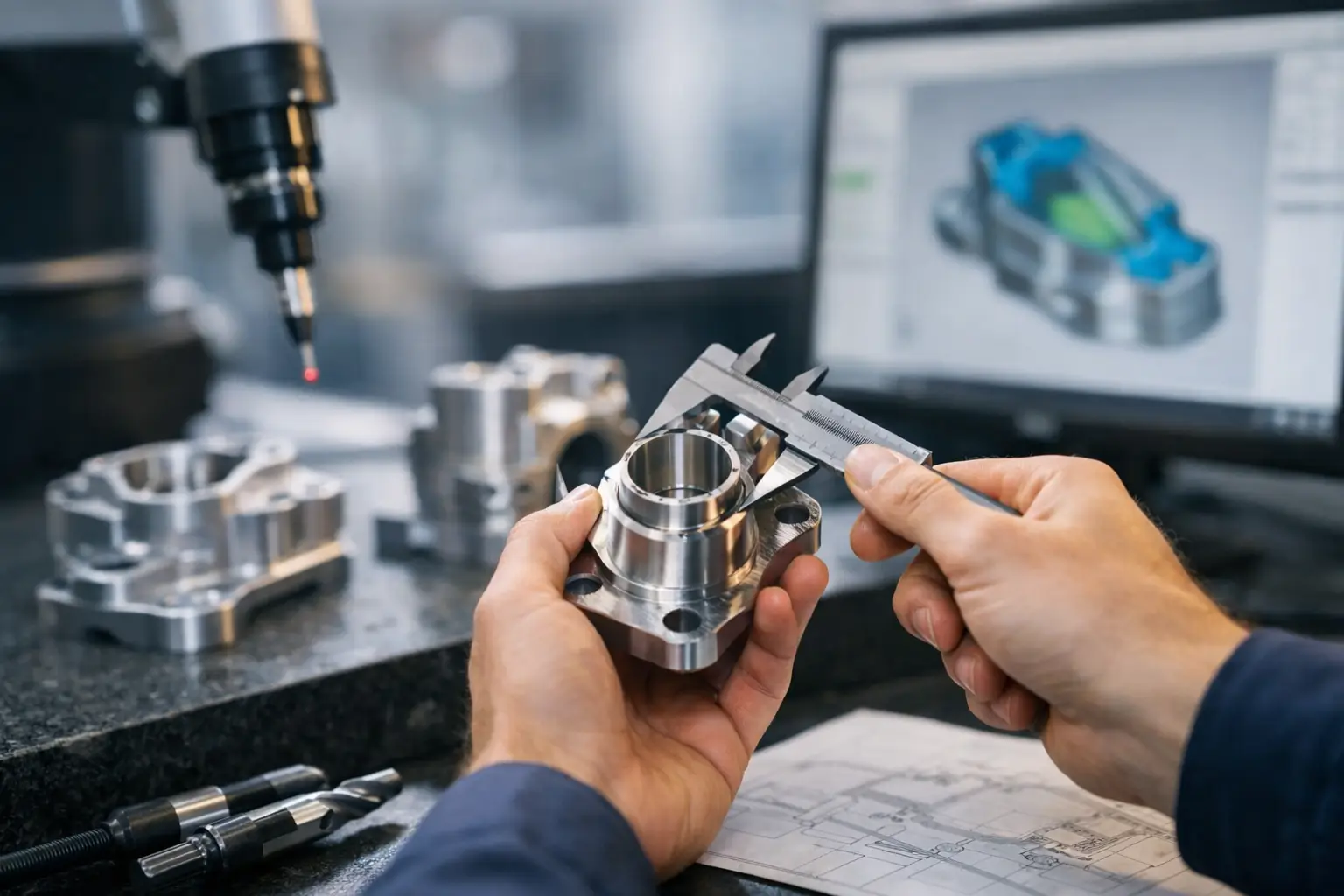
To improve part manufacturability, engineering must consider how a design will be produced, measured and assembled before it reaches the factory. A functional design can still be expensive or unstable when it requires difficult tooling, narrow tolerances or excessive setups.
Design for manufacturing reduces that risk while protecting the product’s required performance.
Choose the production process early
Geometry should suit the intended process and volume. CNC machining rewards accessible features and sensible tool radii; sheet metal needs practical bend relief and standard thicknesses; casting requires draft, wall control and allowance for shrinkage.
Compare processes using lifetime volume, tooling, lead time and quality—not only prototype convenience. The cost drivers of manufactured parts help structure the decision.
Simplify geometry without losing function
Remove features that do not support fit, strength, safety or appearance. Reduce deep pockets, thin walls, inaccessible holes and unnecessary undercuts. Use standard tool sizes and radii where possible. A simpler design often reduces cycle time, scrap and inspection.
Specify tolerances by function
Every tight tolerance adds process and measurement demands. Identify critical interfaces, then allow realistic variation elsewhere. Use a consistent datum system and define how characteristics will be measured.
Geometric tolerancing can communicate function more effectively than long chains of plus/minus dimensions, provided the supplier and inspector interpret it consistently.
Select materials with supply and processing in mind
Material choice affects machinability, forming, welding, heat treatment, coating and availability. A special grade may offer a small performance gain but create long lead times or minimum orders. Compare standard alternatives through an engineering review.
Reduce setups and handling
Features that can be produced from one orientation are usually more stable and economical than parts requiring repeated reclamping. Establish accessible datums and consider how the component will be fixtured. Avoid cosmetic surfaces that must be handled during several operations.
Design assemblies for error prevention
Reduce part count and use features that make incorrect orientation or sequence impossible. Standardise fasteners, provide tool access and define torque or test requirements. The industrial assembly guide explains the related production controls.
Involve suppliers before design freeze
Capable suppliers can identify tooling, material and measurement constraints that are not visible in CAD. Ask for documented DFM feedback before committing to tooling or series production. Evaluate every suggestion against product function; cheaper is not always better.
For a controlled transition, connect DFM to the engineering-to-series-production process.
Validate with representative production
A prototype made by a flexible method may not prove manufacturability at volume. Use pilot parts made with intended materials, tooling and process conditions. Measure yield, cycle time, critical dimensions and assembly results.
Validate the redesign before release
A manufacturability proposal should be checked against product function, assembly, service life and regulatory requirements. Record why each change is acceptable and update the controlled drawing, bill of materials and inspection criteria. A lower-cost feature is not an improvement if it moves risk into assembly or field performance.
Use a prototype, first article or controlled pilot batch when the change affects critical geometry, material or load paths. The results should be reviewed against a documented supplier quality and inspection plan.
Make manufacturability a repeatable gate
Include a DFM review before quotation, before tooling release and whenever volume or process changes materially. Involve manufacturing and quality alongside design engineering. This turns manufacturability from a one-off cost exercise into a controlled part of product development and supplier transfer.
Document the agreed design rules for related product families so that later variants do not repeat the same manufacturing problems. Supplier feedback is most valuable when it becomes reusable engineering knowledge.
Conclusion
Improving part manufacturability is a cross-functional engineering task. Process-appropriate geometry, functional tolerances, available materials and supplier feedback reduce total cost and launch risk. TOS combines DFM, supplier knowledge and validation to turn designs into repeatable production.