
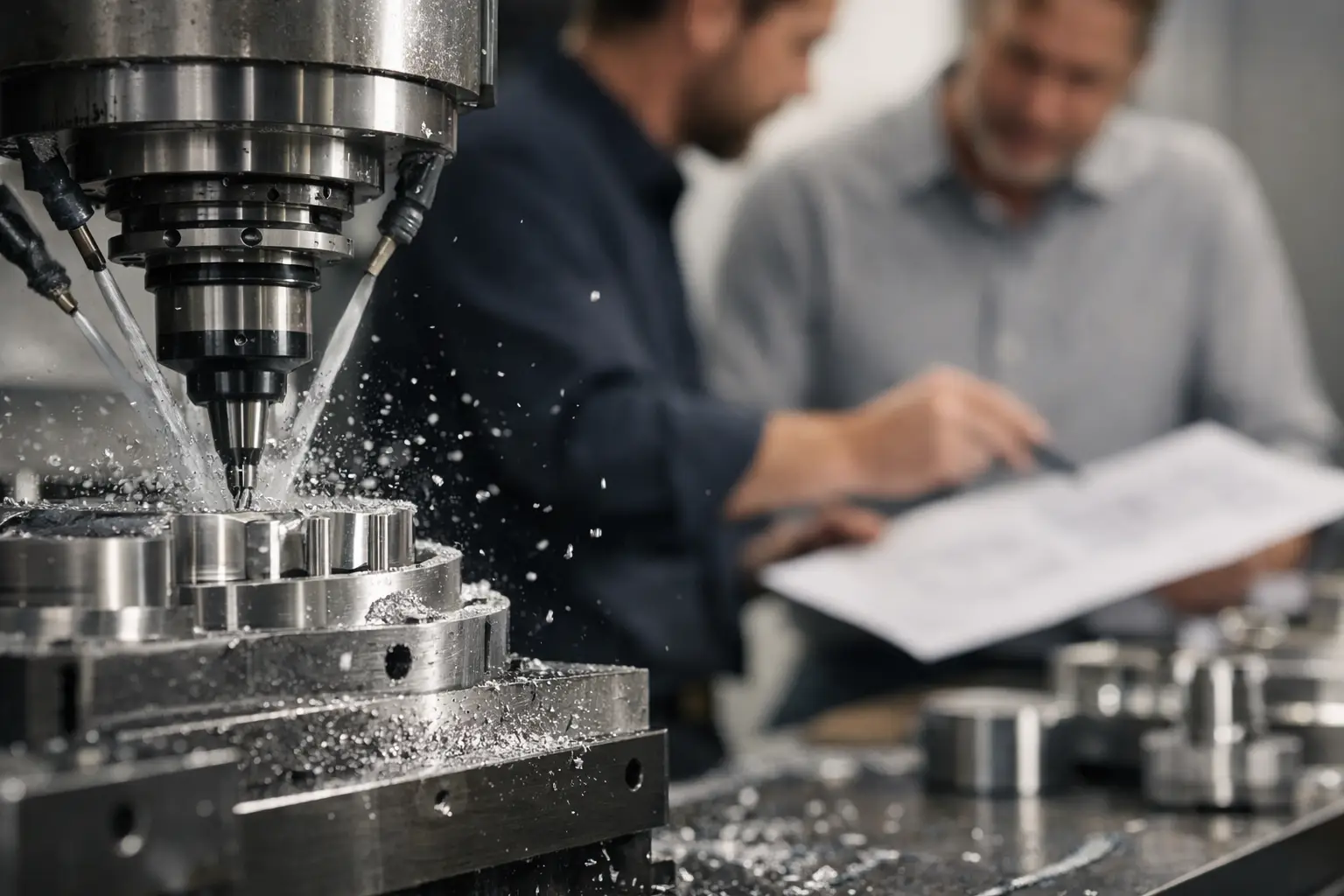
Outsourcing CNC machining can provide extra capacity, specialist expertise and a lower total production cost. But a competitive unit price is only valuable when the parts also arrive on time, meet the drawing and perform consistently from one batch to the next. The real task is therefore not simply to find a machine shop. It is to build a controlled process covering manufacturability, materials, tolerances, inspection, finishing, packaging and logistics.
This guide explains how OEMs and industrial buyers can outsource milled and turned parts without losing control. It focuses on the decisions that prevent unclear quotations, non-conforming parts and avoidable delays.
When does outsourcing CNC machining make sense?
External CNC capacity is useful when your own machines are fully loaded, when demand varies or when a component needs capabilities that are not available in-house. Examples include five-axis milling, complex turning, tight-tolerance features, specialist materials and recurring production that would otherwise occupy valuable internal capacity.
Outsourcing can also prevent capital expenditure. A new machine is not just a purchase: it requires programming, tooling, operators, maintenance, metrology and production planning. A qualified external supplier spreads those resources over several customers. This can make the overall cost more predictable, particularly for low-to-medium volumes and mixed product families.
The decision should still be based on total cost rather than hourly rates. Include engineering time, tooling, quality documentation, rejected parts, transport, inventory and the internal effort required to manage a supplier. Our guide to reducing manufacturing costs through outsourcing explains this broader calculation.
Start with a complete technical package
Many CNC problems begin before a machine is switched on. A 3D model helps with programming, but it does not always define every requirement. The request for quotation should therefore include a controlled 2D drawing, the correct CAD files, material grade, revision level, quantities and all applicable finishing and documentation requirements.
Mark critical-to-quality dimensions explicitly. Define general tolerances only where they are genuinely appropriate and use specific tolerances for functional interfaces. Add surface roughness, thread standards, deburring expectations, edge conditions, heat treatment, coating and cleanliness requirements where relevant. If material certificates or inspection reports are required, make that clear in the quotation stage.
Do not use an unnecessarily tight tolerance as a substitute for understanding the function. It can require extra operations, slower machining and more measurement without improving the product. A structured design-for-manufacturing review can identify expensive features, difficult tool access and tolerances that do not match the functional need.
Check whether the supplier fits the part
Machine-list comparisons are not enough. A reliable supplier for large steel fabrications may not be the best source for small aluminium housings, and a prototype shop may struggle with scheduled repeat production. The right match depends on part size, geometry, material, tolerances, annual volume, batch size and required secondary processes.
Assess the supplier against questions such as:
- Has the supplier produced comparable parts and materials?
- Does the available machine envelope suit the component?
- Can the supplier hold the critical tolerances under production conditions?
- Are suitable measuring instruments and trained inspectors available?
- How are tools, fixtures, programmes and revisions controlled?
- Can finishing, heat treatment and packaging be managed without losing traceability?
- Is sufficient capacity reserved for repeat orders?
Certification can support supplier qualification, but a certificate is not proof that a specific part will be made correctly. Review the scope of certification, audit the relevant process where risk justifies it and confirm performance through a controlled sample order. For a broader method, see how to choose a reliable manufacturing partner.
Use DFM to control cost before production
The largest CNC savings are often made in the design rather than during price negotiation. Deep pockets, small internal radii, thin walls, long slender features and hard-to-reach surfaces can add setups, special tools and machining time. A supplier that reviews manufacturability before quoting can often suggest a simpler route while preserving function.
Material selection also matters. Two alloys with similar performance may have very different availability, machining behaviour and lead times. Standard stock sizes can reduce waste. Combining features into one setup can improve accuracy, while separating a non-critical feature may simplify the main operation. These decisions should be agreed with engineering and documented before the drawing is released.
When the part is still developing, a controlled prototype manufacturing stage can validate both design and process. The prototype should not be treated as automatic proof of series capability: series tooling, cycle time and inspection frequency may be different.
Define an inspection plan, not just a final check
Quality control should be proportional to risk. Identify the features that influence fit, safety, sealing, alignment or performance, then decide how and when they will be measured. The plan may combine incoming material verification, in-process checks, first article inspection and final sampling.
A first article inspection is particularly valuable for a new part, a new supplier, a major revision or a changed production route. It confirms the interpretation of the drawing before the full batch is completed. For recurring parts, retain the approved programme, fixture data and inspection records so later orders start from a controlled baseline.
Measurement method matters. A feature cannot be considered controlled simply because a value appears on a report. The measuring equipment must be suitable for the tolerance and the part must be measured under defined conditions. For high-risk characteristics, agree traceability, calibration and retention of records. TOS can also coordinate independent quality control before shipment.
Manage surface treatments and secondary operations
Many machined parts are not complete when they leave the CNC machine. Anodising, powder coating, galvanising, grinding, heat treatment, marking and assembly can affect dimensions and appearance. These operations must be included in the process plan rather than added at the end.
Protect threaded holes, sealing faces and electrical contact areas where necessary. State whether dimensions apply before or after finishing and consider coating thickness in the tolerance stack. If cosmetic quality is important, define an approved sample, viewing conditions and acceptable variation. Central coordination reduces the risk that a good machined part is damaged or altered during the next operation.
Plan series production and logistics
A successful sample is the start of supplier control, not the end. For repeat production, agree forecasts, release quantities, lead times, safety stock, packaging and escalation routes. Monitor delivery performance and non-conformities over time. A stable process should become easier to manage, not require the same clarification on every order.
Packaging is part of quality. Separate delicate surfaces, prevent corrosion and stop parts from moving during transport. Label each batch so material, revision and inspection documentation can be matched to the shipment. For international production, consolidate transport and customs documentation into the delivery plan.
Where one component needs several manufacturing steps, a single coordinating partner can reduce handovers. TOS combines engineering support, supplier selection, quality assurance and supply-chain coordination within one engineering and manufacturing outsourcing process.
A practical outsourcing CNC machining checklist
- Release controlled drawings and CAD files with matching revisions.
- Define material, critical dimensions, finish and documentation.
- Qualify the supplier for the specific part and production volume.
- Complete a DFM review before freezing the quotation.
- Approve a first article before starting the full series.
- Agree inspection frequency, records and non-conformance handling.
- Control secondary operations, packaging and transport.
- Review cost, quality and delivery performance after every early batch.
Outsource CNC machining with clear accountability
Outsourcing works best when technical responsibility remains visible throughout the chain. The buyer defines the functional requirements; the manufacturer demonstrates a capable process; and a coordinating partner ensures that drawings, inspections, finishing and delivery stay aligned. That structure creates the flexibility of external capacity without turning every order into a separate recovery project.
If you want to evaluate a machined component or transfer a recurring series, send the drawing, annual volume and quality requirements through our contact page. We can assess manufacturability, supplier fit and the controls needed for a reliable production route.