
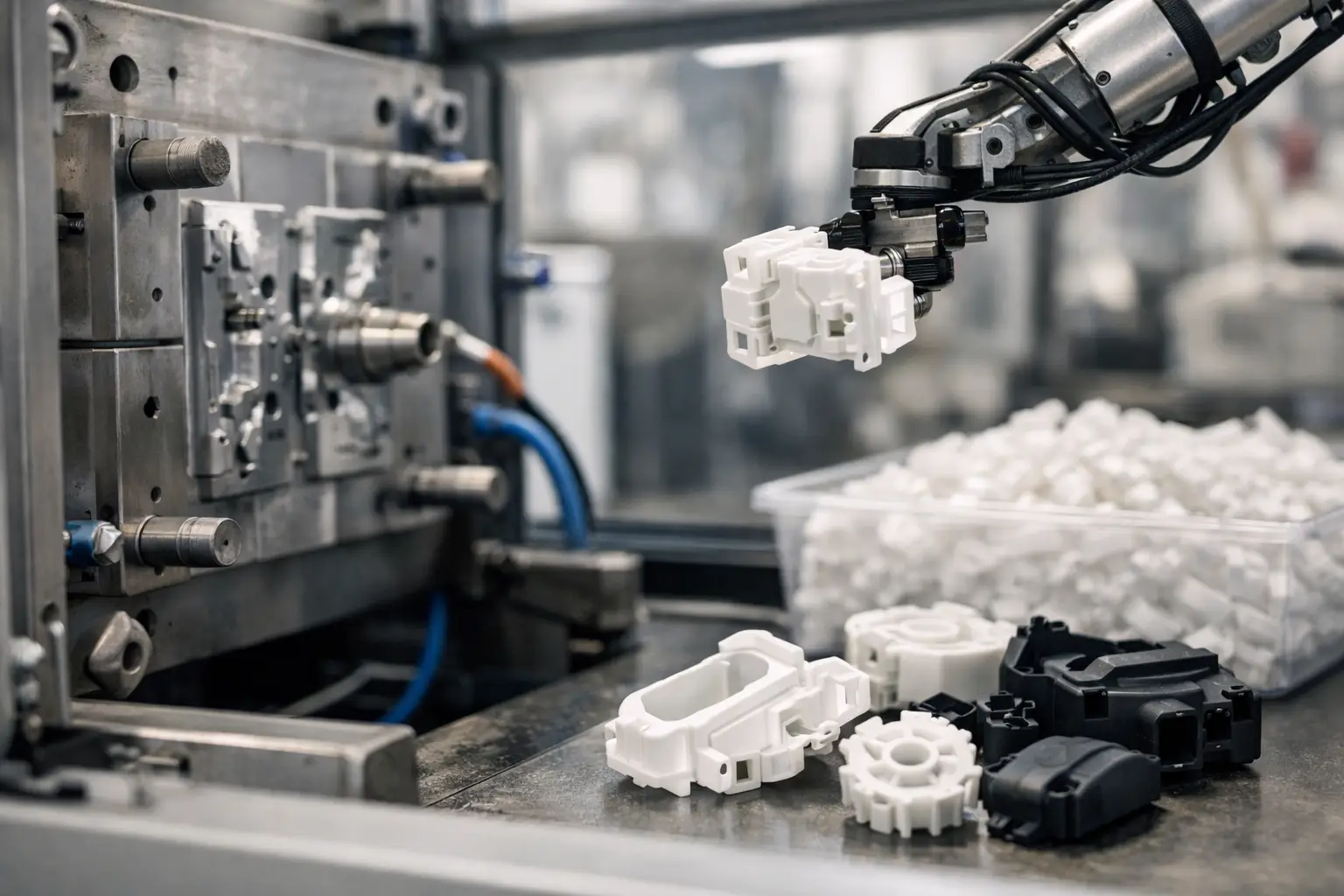
Plastic injection moulding can produce thousands or millions of identical parts, but repeatability is not automatic. Reliable series production depends on a stable mould, controlled raw material, a validated process window and disciplined quality control. The work completed before the first full production run often determines whether later batches arrive on time and within specification.
This guide explains how buyers and engineers can make plastic injection moulding series production predictable. If you are still comparing suppliers and general outsourcing options, also see our guide to outsourcing plastic injection moulding.
Start with a mouldable and measurable part design
Wall thickness, ribs, bosses, draft angles, undercuts and gate location influence filling, cooling and ejection. Abrupt thickness changes can cause sink marks, warpage or internal stress. Features that are difficult to fill or inspect increase the chance of unstable production. A design-for-manufacture review should therefore take place before the tool is released.
Define the features that are genuinely critical to fit, function or safety. Tolerances copied onto every dimension make the mould and inspection plan unnecessarily expensive. Our guide on improving part manufacturability explains how early engineering decisions can remove cost without compromising performance.
Control the polymer and its preparation
The material specification should state the exact polymer grade, approved colour or masterbatch, permitted recycled content and any flame-retardant, UV or food-contact requirements. For hygroscopic materials, drying time, temperature and maximum moisture content matter. Mixing grades or using poorly dried resin can change dimensions, surface appearance and mechanical performance.
Lot numbers should be recorded so finished parts can be traced back to incoming material. When an alternative resin is proposed, treat it as a controlled change. A similar commercial name does not guarantee identical shrinkage, viscosity or long-term behaviour.
Validate a robust process window
A single successful sample run is not enough. The supplier should establish acceptable ranges for melt temperature, mould temperature, injection speed, holding pressure, cooling time and cycle time. The aim is to identify a process window that produces conforming parts despite normal variation in material and ambient conditions.
First-off samples should be measured against the drawing and tested under realistic assembly or load conditions. For important programmes, capability studies on critical dimensions provide stronger evidence than a small sample of visually acceptable parts. Include these checks in a documented supplier quality and inspection plan.
Balance cavities and monitor the mould
In a multi-cavity tool, parts from different cavities may not behave identically. Each cavity should be identified where practical, and critical measurements should cover every cavity. This makes it possible to find an imbalance or local tool wear before it affects an entire shipment.
The mould also needs a maintenance plan covering cleaning, lubrication, vents, ejector pins, cooling channels and wear components. Record shot count and repairs. Preventive maintenance is usually less disruptive than waiting for flash, short shots or sticking parts to stop production.
Use clear in-process quality controls
A reliable control plan combines machine parameters, visual standards and dimensional checks. Typical controls include:
- material and colour verification before production;
- first-off approval after setup or a material change;
- scheduled dimensional checks on critical features;
- visual standards for flash, sink, burn marks and contamination;
- cavity-specific sampling where relevant;
- final quantity, labelling and packaging verification.
Nonconforming parts must be physically segregated and recorded. The response plan should define when production stops, who approves a restart and whether earlier output needs additional inspection.
Manage engineering changes formally
Uncontrolled changes are a common cause of unexpected variation. A supplier should not alter material, mould steel, gate geometry, process location or key parameters without approval. Each accepted change should update the drawing, revision level, control plan and sample approval. Good manufacturing supply chain traceability ensures that every shipment can be linked to the correct revision and production records.
Protect output, packaging and continuity
Series production planning should also cover capacity, maintenance downtime and backup arrangements. Agree realistic cycle time and available shifts rather than relying on theoretical machine capacity. Packaging must prevent scratches, deformation, dust and moisture damage during transport and storage. For cosmetic components, approved reference samples and protective separators can prevent subjective disputes.
When production is sourced internationally, logistics and customs should be planned alongside manufacturing. Our guide to logistics and customs for outsourced manufacturing explains the main points.
Conclusion
Reliable plastic injection moulding series production is built on design review, controlled material, a validated process window, cavity-level monitoring and disciplined maintenance. TOS coordinates technical review, supplier selection, quality control and logistics so that series production remains stable from approval to repeat orders. Contact TOS Outsourcing to discuss a plastic component or production programme.