
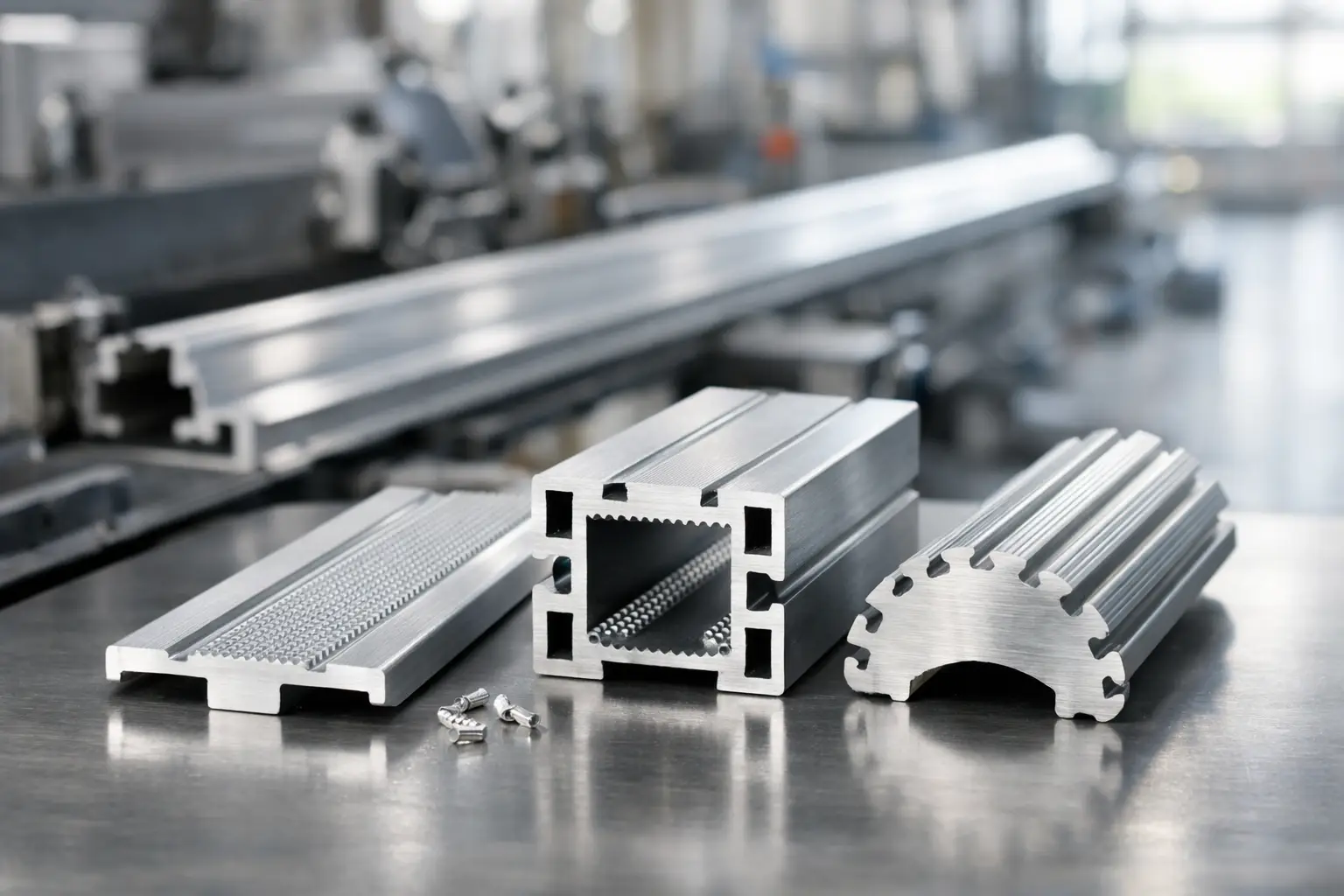
Custom aluminium extrusion can combine low weight, structural strength and integrated features in one continuous profile. It is widely used for machine frames, enclosures, guides, heat-management parts and transport applications. The economic advantage, however, depends on making the profile easy to extrude and controlling what happens after it leaves the press.
This guide explains how to specify, source and validate custom aluminium extrusion without losing control of tooling, tolerances, finishing or final component quality.
How aluminium extrusion works
A heated aluminium billet is forced through a shaped die. The emerging profile is cooled, stretched, cut and heat treated before any secondary fabrication or surface finishing. Die design, alloy, billet temperature, extrusion speed and profile geometry all influence dimensional stability and mechanical properties.
The process can integrate ribs, screw ports, channels and functional surfaces that would otherwise require separate parts. Yet every feature also affects metal flow. The profile should therefore be developed with the extruder, not presented as a finished design after all decisions have been fixed.
Design the profile for stable extrusion
Good extrusion design aims for balanced wall thickness and smooth metal flow. Sudden changes from thick to thin sections can cause distortion or uneven cooling. Very narrow channels, deep pockets and sharp internal corners can increase die stress and reduce stability. Generous radii and symmetrical geometry are generally easier to control.
Identify which features are genuinely critical. It may be more economical to extrude a robust near-net profile and create a precision hole, sealing face or thread with secondary machining. A broader engineering and manufacturing review helps compare profile complexity with downstream operations.
Choose the alloy and temper by function
Alloy selection affects extrudability, strength, corrosion resistance, machinability, weldability and finishing. Common 6xxx-series alloys offer a useful balance for industrial applications, but the correct grade depends on structural loads, environment and later processing.
The temper describes the heat-treatment condition and must be stated with the alloy. If mechanical properties are important, define the applicable standard, test evidence and any limitations after welding or forming. Avoid accepting an “equivalent” alloy without a documented engineering review.
Specify tooling ownership and maintenance
The extrusion die is a key commercial and technical asset. The purchase agreement should state who owns it, where it is stored, whether it may be used for other customers, how maintenance is handled and what happens if the supplier relationship ends.
Initial samples may require die correction to achieve the intended dimensions. Agree how many correction rounds are included and how approval will be recorded. The approved profile and die status should be linked to a drawing revision.
Use realistic tolerances
Extruded profiles naturally show variation in wall thickness, straightness, twist, flatness and cross-sectional dimensions. Tolerances depend on profile size, shape, alloy and whether the section is solid, semi-hollow or hollow. Do not apply general machining tolerances to the whole profile.
Define critical dimensions and their measurement method. For long profiles, specify whether straightness and twist are assessed over a segment or the total length. When tighter local accuracy is required, consider machining after extrusion. This approach often delivers better total cost than demanding exceptional extrusion tolerances everywhere.
Plan secondary operations and finishing
Commercial components usually need cutting, CNC machining, punching, drilling, bending, welding, anodising, powder coating or assembly. These steps should be included in the sourcing plan from the start because they affect datums, handling marks, corrosion protection and dimensional results.
For machined features, apply the controls described in our guide to outsourcing CNC machining. If anodising or coating is required, reserve dimensions for coating build-up and define cosmetic acceptance zones, colour references and contact points.
Validate first articles and series quality
A first-article inspection should cover material certificates, cross-section dimensions, critical lengths, straightness, twist, surface condition and any fabricated features. Cut samples can be used where internal geometry or wall thickness cannot be verified externally.
Series inspection must reflect risk. Critical-to-function dimensions may require regular checks, while stable non-critical features can use periodic sampling. Keep records by batch and trace the extrusion lot through fabrication and finishing. A structured supplier quality inspection plan makes responsibilities and release points explicit.
Understand total cost
Compare more than price per metre or kilogram. Include die cost, minimum billet or order quantities, setup, scrap, heat treatment, cutting losses, machining, finishing, inspection, packaging and freight. Profile optimisation may save weight, but a complex die or low annual volume can offset that benefit.
The technical component cost breakdown provides a consistent basis for comparing quotations.
Conclusion
Successful custom aluminium extrusion starts with a profile designed for metal flow and ends with controlled fabrication, finishing and inspection. Clear alloy and temper requirements, documented tooling ownership, realistic tolerances and approved first articles reduce both technical and commercial risk. TOS can coordinate the complete route from DFM and supplier selection to finished, inspected components.