
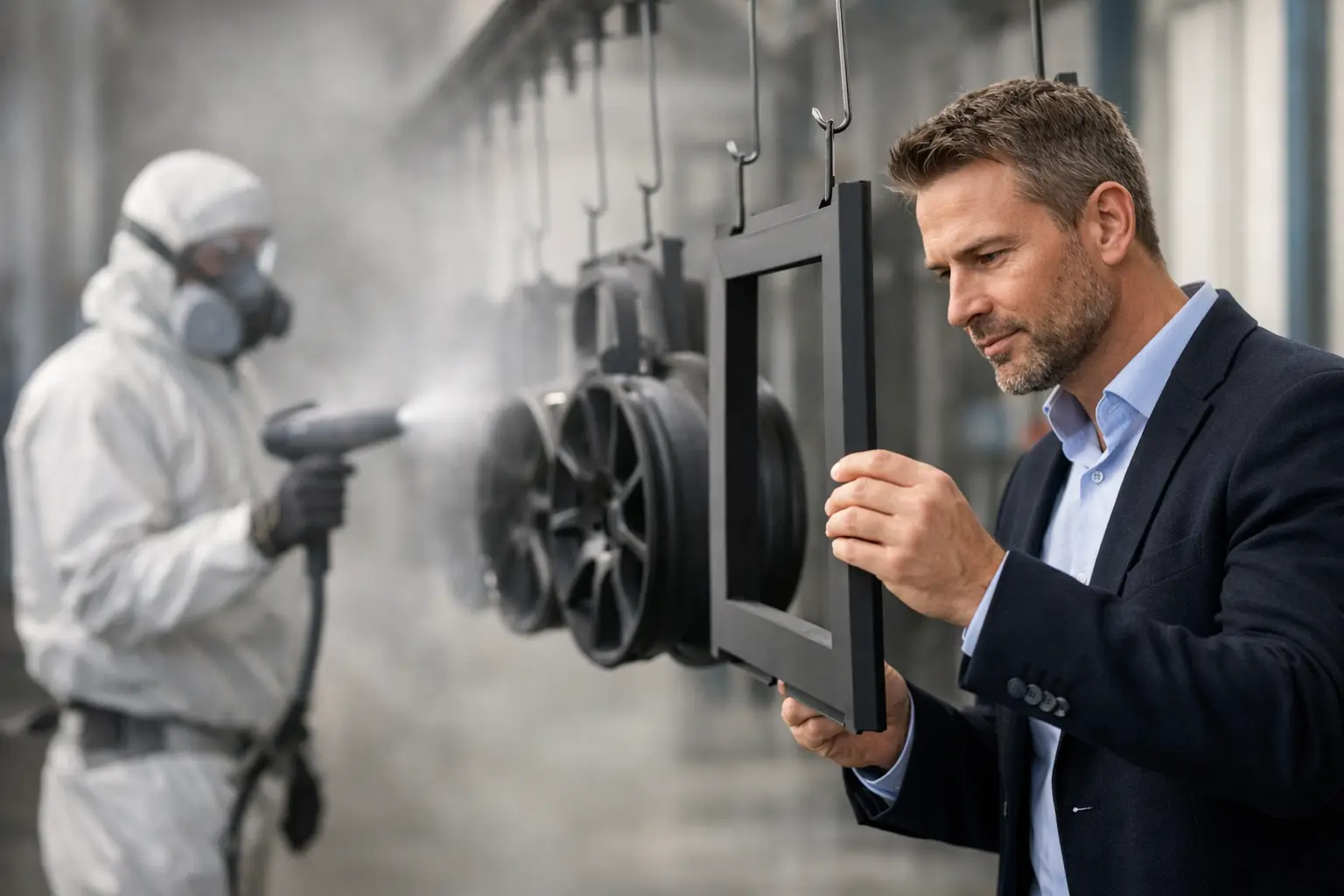
Outsourcing powder coating can provide a durable, consistent finish without investing in pretreatment equipment, spray booths and curing ovens. The quality of the result, however, depends on much more than selecting a colour. Substrate condition, pretreatment, coating chemistry, film thickness, curing and handling all need to match the product’s environment and function.
A useful specification tells the coating supplier what performance is required and how it will be verified. Without that information, two visually similar finishes can deliver very different corrosion resistance, adhesion and service life.
How the powder-coating process works
Powder coating is normally applied as a dry, electrically charged powder to a grounded part. The deposited layer is then heated so the powder flows and cures into a continuous film.
A typical industrial process includes:
- inspection and masking of the incoming parts;
- cleaning and surface pretreatment;
- drying and controlled hanging or racking;
- electrostatic powder application;
- curing at the specified metal temperature for the required time;
- cooling, inspection and packaging.
Each step affects the final result. A correct colour and gloss cannot compensate for poor cleaning, incomplete cure or an unsuitable coating system.
When outsourcing powder coating is the right choice
External coating is attractive when volumes do not justify an in-house line, when parts need specialist pretreatment or when colour and performance requirements vary by project. It also allows the manufacturing supplier to focus on cutting, forming, welding or machining while a qualified coater manages the finish.
Outsourcing is common for sheet-metal enclosures, welded frames, machine components, aluminium profiles and fabricated assemblies. The commercial decision should include transport, hanging density, masking, inspection and packaging—not only the quoted coating price.
Start with the substrate and service environment
The correct coating system begins with the base material and exposure conditions. Steel, galvanised steel and aluminium require different cleaning and pretreatment. Indoor office equipment has different needs from outdoor machinery, coastal installations or parts exposed to chemicals.
Define whether the primary objective is appearance, corrosion resistance, abrasion resistance, electrical insulation, chemical resistance or a combination. Also state the expected service environment, design life and maintenance conditions. The powder supplier or coater can then recommend an appropriate resin system and pretreatment.
Pretreatment determines adhesion and corrosion performance
Oil, dirt, rust, scale, welding residue and other contamination can prevent proper adhesion. Cleaning must be suitable for both the substrate and the soils present on the part.
Depending on performance needs, pretreatment may include mechanical preparation, conversion coating or multi-stage chemical cleaning and rinsing. The correct choice is application specific. A simple indoor part may need a lighter system than an exterior component with a long corrosion-resistance requirement.
Welds, laser-cut edges, sharp corners and enclosed areas require special attention. Residue trapped in joints can later cause staining, blistering or corrosion. Parts should therefore be designed and prepared with the coating route in mind.
Select the correct powder chemistry
Powder formulations differ in weathering, chemical resistance, flexibility, hardness and cure behaviour. Common families include epoxy, polyester and hybrid systems.
Epoxy powders can provide strong mechanical and chemical performance but generally have limited resistance to outdoor ultraviolet exposure. Polyester systems are widely used for exterior applications where colour and gloss retention matter. The correct formulation should be selected with the coater or powder manufacturer using the complete performance specification.
Colour should be identified with a controlled reference such as a RAL code where appropriate, but the code alone does not define gloss, texture, batch-to-batch variation or acceptable visual defects.
Specify film thickness and edge coverage
Film thickness influences appearance, protection, fit and cost. Too little coating can reduce coverage and corrosion resistance. Too much can create orange peel, sagging, poor cure or assembly problems.
State the target or permitted thickness range and identify surfaces where build-up affects mating parts, threads, holes, electrical contacts or grounding points. These areas may need masking.
Sharp edges are difficult to coat evenly and often receive a thinner effective film. Product design can improve coverage by using suitable radii and avoiding inaccessible recesses. For a broader manufacturability approach, see outsourcing engineering and manufacturing.
Control curing by metal temperature and time
The oven setting alone does not prove that the coating is fully cured. The important variables are the actual temperature reached by the part and the time it remains within the specified cure window.
Heavy and light components heat at different rates. Mixed loads can therefore create inconsistent results if the oven cycle is not validated. Temperature profiling can confirm that the coldest relevant area of the part achieves the powder manufacturer’s cure schedule.
Under-cure may reduce adhesion, hardness and chemical resistance. Excessive heat can change colour or damage the coating and substrate. Cure control should be part of the supplier’s process documentation.
Design parts for coating and handling
Parts need suspension points for reliable electrical grounding and safe handling. Rack marks should be located where they do not affect function or visible appearance. Closed sections may need drainage or venting, depending on the cleaning process.
Clarify whether threads, bearing seats, sealing faces, weld studs or identification areas must remain uncoated. Masking instructions should identify exact locations and permissible edge conditions.
If coating is part of a larger outsourced production route, link the finish specification to the controlled drawing. Our guide to outsourcing metalworking explains how finishing should be integrated with fabrication and inspection.
Define inspection and test requirements
A risk-based inspection plan may include:
- visual assessment for colour, gloss, texture, coverage and defects;
- dry film-thickness measurement;
- adhesion testing;
- cure verification;
- impact or bend testing where flexibility matters;
- corrosion or environmental testing for qualified systems;
- masking and dimensional checks on functional interfaces;
- batch identification and process records.
Acceptance criteria should be agreed before the first order. An approved sample can help control cosmetic expectations, but it should be stored and identified properly.
TOS can organise local quality control at the coating supplier or as part of the complete manufacturing route.
Package coated parts to prevent transport damage
A conforming finish can still be damaged through poor packing. Parts should be sufficiently cooled before contact with packaging, separated at vulnerable surfaces and protected against movement, moisture and abrasion.
Foams, films and separators must be compatible with the coating. Long storage under pressure or heat can mark some finishes. Define stacking limits and lifting points for heavy assemblies.
Information to include in a powder-coating request
- part drawing, quantity, weight and dimensions;
- base material and current surface condition;
- indoor or outdoor service environment;
- required colour, gloss and texture;
- coating chemistry or performance requirements;
- pretreatment and corrosion requirements;
- target film thickness and measurement locations;
- masking, rack-mark and cosmetic-area instructions;
- inspection, test and reporting requirements;
- packaging and delivery expectations.
Common powder-coating defects and causes
Poor adhesion or blistering can result from contamination, incorrect pretreatment or trapped moisture. Thin coverage often appears around edges, recesses and Faraday-cage areas. Orange peel can relate to film build, application settings or cure behaviour. Craters and fisheyes frequently point to contamination.
Corrective action should address the process cause, not only recoat the affected part. Rework can change dimensions, appearance and material condition, so it should be approved and documented.
A practical outsourcing workflow
- Define the substrate, environment and required performance.
- Select pretreatment and powder chemistry with a qualified supplier.
- Complete colour, gloss, film-thickness and masking specifications.
- Review the part for hanging, drainage and edge coverage.
- Approve a first-off or reference sample.
- Validate cure and inspection methods.
- Inspect production and release the batch against agreed criteria.
- Package and transport the parts without damaging the finish.
Control the complete finish, not only the colour
Outsourcing powder coating works reliably when the supplier receives a performance-based specification and controls pretreatment, application and cure as one process. Clear inspection and packaging requirements then protect the result through final assembly.
TOS can coordinate metal production, powder-coating suppliers, inspections and delivery through one accountable route. Contact us to discuss the substrate, application and finish your project requires.