
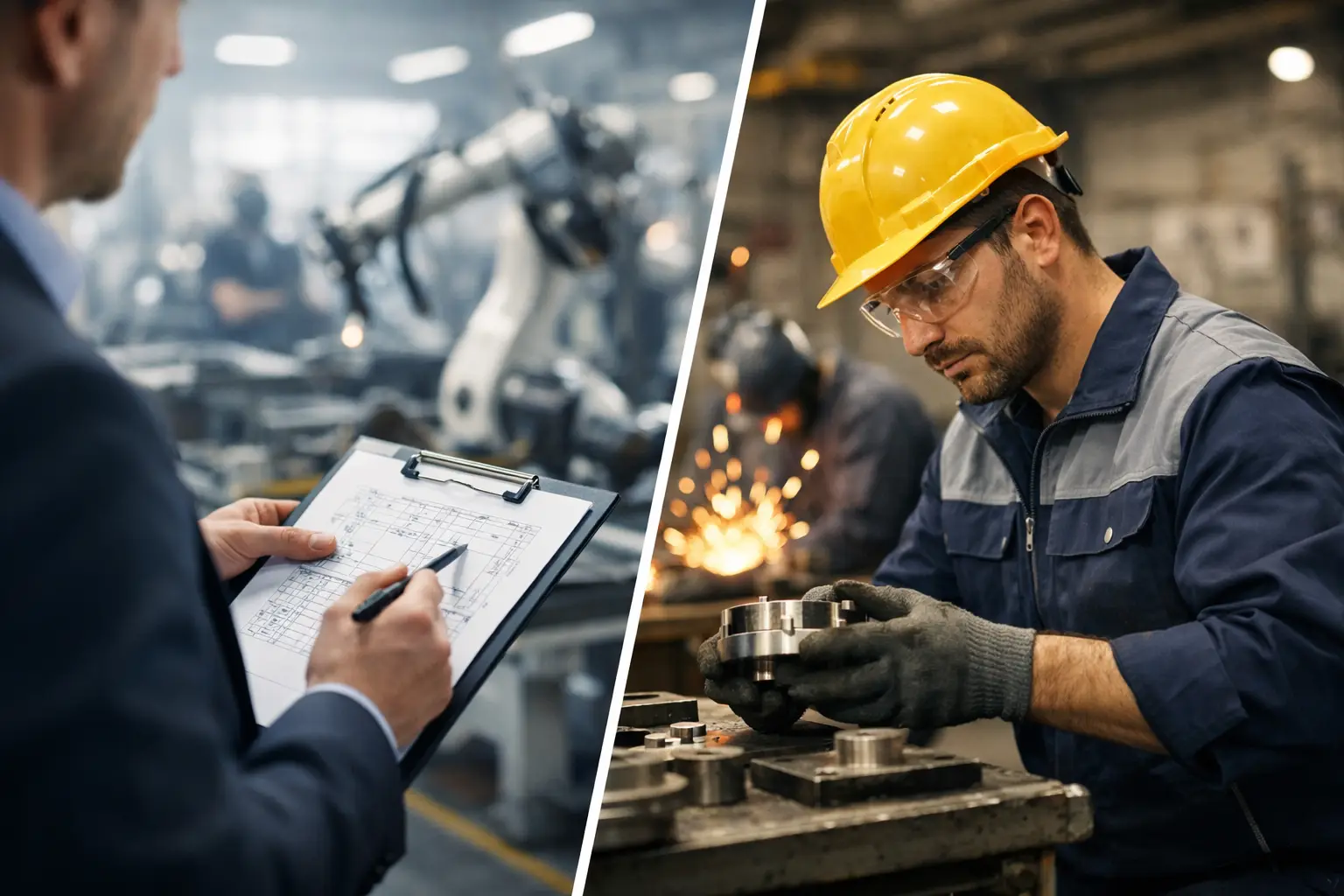
Outsourcing custom manufacturing can provide capacity, specialist knowledge and a more flexible cost structure. It can also expose an OEM to quality, intellectual-property and supply risks when the make-or-buy decision is based only on a quotation.
The right question is not whether outsourcing is universally better than in-house production. It is which operations should remain under your direct control and which can be performed more effectively by qualified external suppliers.
The make-or-buy decision for custom industrial parts
Custom parts differ from standard purchased items because the supplier must interpret your design, process requirements and acceptance criteria. The decision therefore affects engineering, quality and operations as well as procurement.
In-house production may be preferable when a process is central to product performance, changes occur continuously or manufacturing knowledge directly supports innovation. External production is often stronger when the requirement is stable, specialist equipment is needed or internal capacity cannot scale economically.
Many companies use a hybrid model. They retain design authority, critical testing and final assembly while outsourcing repeat components, specialist processes or complete subassemblies. This protects core knowledge without forcing every manufacturing discipline to remain in-house.
Which custom manufacturing work is suitable for outsourcing?
Strong candidates usually have controlled drawings, repeat demand and measurable quality criteria. These may include machined components, sheet-metal parts, welded structures, castings and assemblies.
Parts that combine several operations can also benefit. For example, a fabricated assembly may require laser cutting, bending, welding, machining, coating and inspection. One managed production route can be more efficient than coordinating each supplier separately. Our guide to outsourcing metalworking explains how these stages can be controlled.
Work is more difficult to outsource when the design is still changing quickly, quantities are extremely low or the required response time is measured in hours. In those situations, local or internal production may remain the better option until the product is mature.
Main risks of outsourcing custom manufacturing
Incomplete technical transfer
A 3D model and drawing may not describe everything a supplier needs. Critical-to-quality dimensions, surface appearance, welding standards, material traceability, packaging and inspection records should be defined explicitly.
Revision errors
Custom manufacturing becomes vulnerable when several drawing versions circulate. One approved data set, a clear release process and recorded engineering changes are essential.
Supplier mismatch
The lowest bidder may lack experience with the material, tolerance, batch size or documentation. Process capability must be verified rather than assumed.
Quality discovered too late
Inspection after delivery is too late when freight has already been paid and the production schedule is at risk. First article inspection and source control reduce this exposure.
Dependency and continuity
A single production source can become a constraint during demand peaks, equipment failure or financial disruption. The sourcing strategy should consider back-up capacity and the time required to qualify an alternative.
Specifications determine whether outsourcing remains controllable
External suppliers cannot rely on the informal knowledge available on your own shop floor. A complete technical package should state the approved revision, material, tolerances, finishes, standards, test requirements, labelling and packaging.
Not every dimension needs the same inspection intensity. Identify the features that affect fit, function, safety or appearance. The control plan can then concentrate on meaningful risks rather than producing documentation with little operational value.
A manufacturability and product-optimisation review can also remove avoidable cost before suppliers quote. Simplifying a tolerance, weld or machining feature is usually cheaper than controlling it throughout every future production batch.
How to qualify a custom manufacturing supplier
Supplier qualification should cover more than certificates and machine lists. Review comparable work, operator skills, inspection equipment, capacity, maintenance, subcontracted processes, revision control and corrective-action discipline.
The first quotation also reveals how a supplier works. Strong suppliers ask technical questions, identify uncertainty and explain assumptions. An unrealistically fast quote with no questions can indicate that important requirements have not been considered.
A prototype or pilot batch is the practical test. It demonstrates whether the supplier can interpret the data, produce the part, report results, manage deviations and meet the agreed timing.
TOS can coordinate the required supplier quality and inspection plan before series production begins.
Cost, capacity and scalability
Outsourcing can convert fixed investment into a variable cost. You gain access to equipment and skilled labour without owning every machine or maintaining capacity for peak demand.
The financial comparison should use total landed cost: production, tooling, quality, packaging, freight, inventory, duties and internal supplier-management time. A low unit price does not compensate for unstable delivery or repeated engineering support.
Scalability should also be tested. Ask how the supplier will add shifts, tooling, material and inspection capacity when volume rises. A route that works for 100 parts may not automatically work for 10,000.
How to outsource custom manufacturing safely
- Segment the work. Keep strategically critical or highly changeable processes close; identify stable work for external production.
- Prepare one controlled technical package. Remove ambiguity before quotation.
- Compare capable suppliers. Evaluate process fit, capacity, quality and total cost.
- Validate the route. Approve a prototype, first article or pilot batch.
- Freeze the series revision. Use formal change control for later updates.
- Set measurable expectations. Track defects, on-time delivery, response time and corrective actions.
- Plan continuity. Understand tooling ownership, data access and alternative capacity.
When a managed outsourcing partner adds value
Managing several suppliers directly can consume the savings that outsourcing was intended to create. Technical questions, quality issues, production milestones and international logistics need a clear owner.
A managed partner acts as the interface between your organisation and the manufacturing network. TOS coordinates the route from drawings and supplier selection through inspection and delivery, with one Dutch point of contact.
For products moving from development into repeat production, see our guide to contract manufacturing from prototype to series. It explains how responsibilities and controls change as volume increases.
Smart move or unacceptable risk?
Outsourcing custom manufacturing is a smart move when the technical package is mature, the supplier is qualified and performance can be measured. It becomes risky when responsibility is fragmented or the decision is driven by piece price alone.
Contact TOS to assess your make-or-buy decision, the suitability of your parts and the controls required for a reliable production route.